
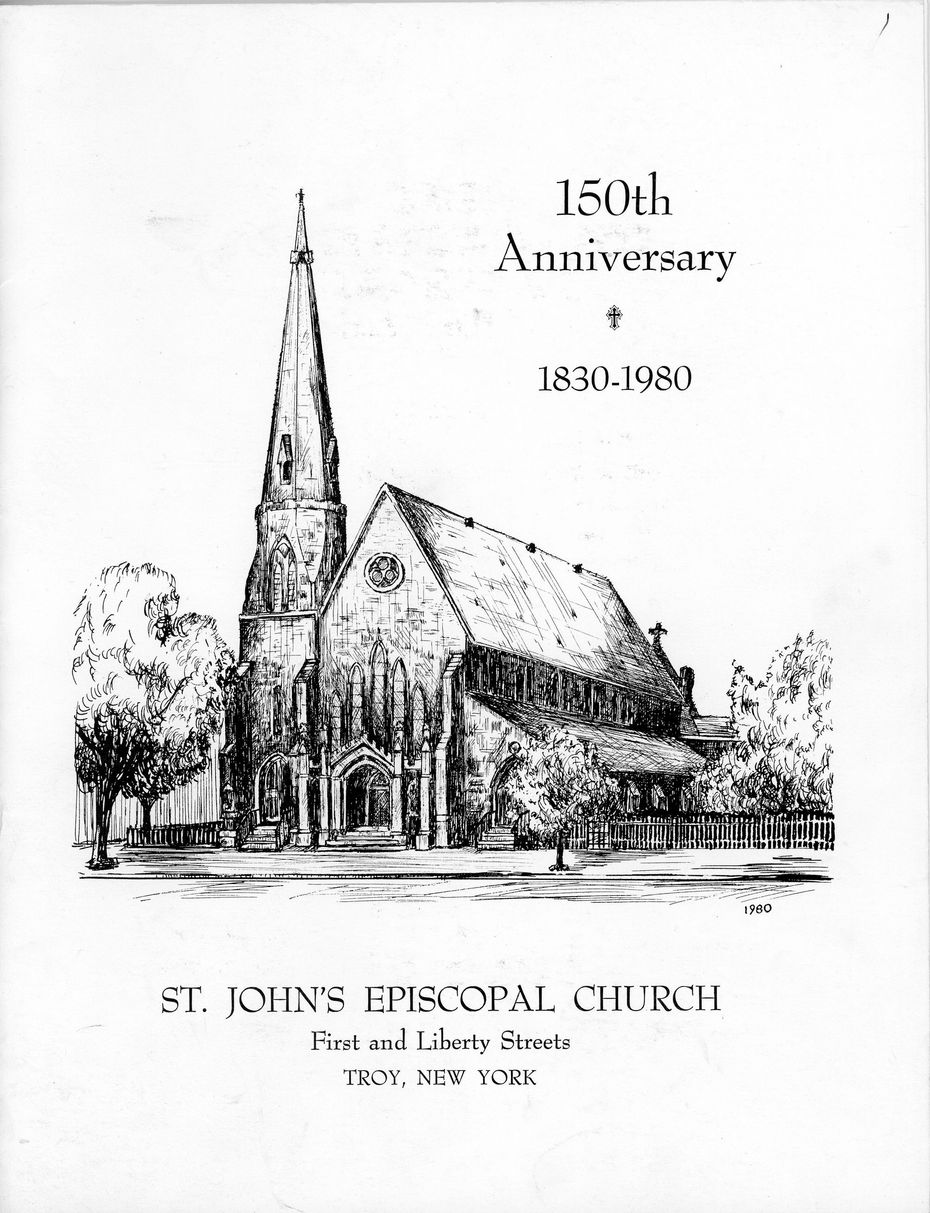
Cover drawing by Herbert A. Page
Stone Upon Stone: A Sesquicentennial
History of St. John's Church, Troy
by
K. Jack Bauer
November 30, 1980
Informal Episcopal worship began in Troy during 1795. A decade would pass before the newly formed St. Paul’s congregation completed its brick church at the northwest corner of Congress and Third Streets and called a minister. The Troy congregation prospered and within 20 years found its building too confining. A new St. Paul’s arose at the corner of Third and State Streets in 1827-28.
By 1830 the growing number of Episcopalians in Troy and the development of residential areas south of Congress Street caused a group of families to consider establishing a second church. Although the evidence is highly circumstantial, there appears to be some reason for suspecting that they included those disenchanted with the “high church” proclivities of the existing parishes in Troy and Lansingburgh. During the fall they met in the Presbyterian Session House at 71 Fourth Street. Satisfied that they could form a viable parish, the small group plunged ahead with its formation on Monday, November 22, 1830. David Buel, a vestryman at St. Paul’s and one of the patriarchs of Troy, chaired the session. Those present adopted articles of incorporation for St. John’s Church. These provided for an annual meeting and annual election of two wardens and eight vestrymen.
The meeting chose Buel and John Whiton as wardens and added as vestrymen a well connected group which included former County Court Judge David Buel, Jr., who, like his father, was a vestryman at St. Paul’s; Lewis Rousseau of the Bank of Troy; the merchant Asahel Gilbert, Jr.; hardware m e r c h a n t Darius Weed; Francis N. Mann, later Judge and Mayor of Troy, who served as vestryman or warden for nearly 50 years; Dr. Charles S. J. Goodrich; the hatter Henry Rousseau; and Dr. Melzar Flagg. They were a good representation of Troy’s dominant professional and mercantile community although except for the Buels and Mann none were economic or social leaders.
What was the town like which St. John’s sought to serve? Troy was at about its peak as a commercial center. Its wholesale merchants dominated the trade of western Vermont and Massachusetts as well as the area to the northward in New York. They were only beginning to feel the damage wrought by the Erie Canal which channeled western goods and travelers down the other bank of the Hudson to Albany. Nevertheless, Troy mercantile houses still operated canal boat lines to the Great Lakes while a pair of steamboats and some 80 sloops ran to New York. New industry, largely stove casting, drew on the readily available Adirondack ores to give increasing employment even as its smoke darkened the skies above the town of 11,000.
Troy was an up and coming town. Street lights dispelled some of the gloom of the late fall night along a River Street which had been paved for the past year. Houses now had numbers while the Troy Museum boasted 14 life-sized wax figures of “distinguished people” among its displays. The shopping district ran along River Street and residences already crowned the slopes of Mt. Ida, north of the Poestenkill. Emma Willard’s Troy Female Seminary, which would play a major role in the story of St. John’s, had been established for nearly a decade on Second Street. A much lesser role in bringing renown to the young settlement was played by the small but unique technical training institution, the Rensselaer School, operated by Amos Eaton on Middleburg Street on the northern edge of the settled area. Its role and prestige would grow to overshadow that of Mrs. Willard’s pioneering school but Rensselaer Polytechnic Institute, as Eaton’s establishment came to be named, was not as closely tied to St. John’s.
The newly appointed vestry, to no one's surprise, decided to purchase the old St. Paul’s Church. Two days before Christmas the senior Buel, Weed, Gilbert, and Mann signed a memorandum of purchase for the building. For $5,000 St. John’s, on January 30, 1831 secured the building, organ, bell, and “other personal property” but agreed to allow St. Paul’s to buy back the structure if the new owners decided to sell. Having bought a church, the congregation turned to their next task: to find a rector. That proved difficult. The first two candidates refused. While the search continued Rev. Aaron Humphrey ministered to the parish, celebrating the first Communion on Easter Sunday, April 3, 1831. Three weeks later he conducted the earliest baptism — furniture dealer William Albro.
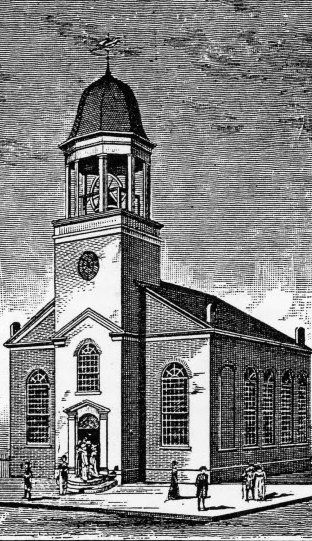
St. John's as it appeared in 1831
Finally on May 24, 1831 Rev. John A. Hicks of Easton, Pennsylvania, who had earlier visited the struggling parish, became its first permanent minister. Since the certificate of his election is dated May 30 we cannot be certain when he took his first service. He found a racially mixed congregation numbering 20 families and 17 communicants. Fourteen of the members* purchased pews when they were sold in June. Pew payments, then as later, were due quarterly and varied according to the location and size of the pew and the ability of the member to contribute. Until 1915 pew rents formed the primary source of operating funds for the parish. Sunday and holiday collections funded specified internal and missionary projects.
One of the difficulties which confront anyone attempting to reconstruct the history of the early years of St. John’s is the burning of the early vestry minutes, probably in the great fire of May 10, 1862. The story which we have is pieced together from the parish registers, scattered correspondence in the church archives, infrequent newspaper notices, and the sermons delivered by Rev. Henry C. Potter on the 30th Anniversary of the parish.
*David Buel, Sr., David Buel, Jr., William Albro, Asabel Gilbert, Benjamin Hatch, Philip Heartt, Luther R. Lesell, Francis N. Mann, Russell Mann, Henry Rousseau, Lewis Rousseau, Abraham D. Spoor, Darius Weed, and Emma Willard.
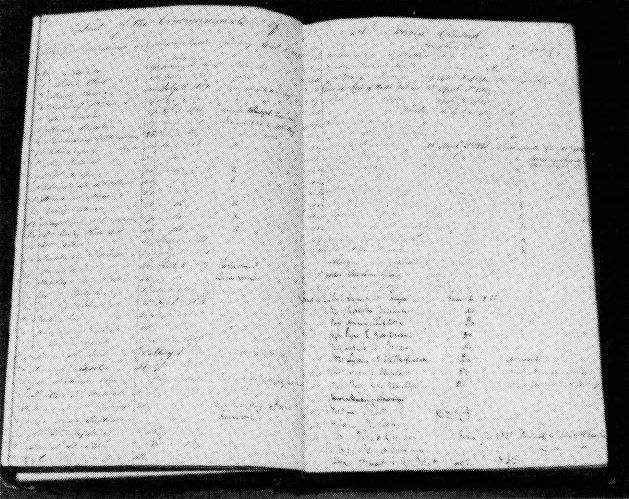
The first pages in the Parish Register contain the names of the original members.
In July 1831 the parish spent $60 for a silver plated tankard, two sets of silver plated cups and plates, and a plated christening bowl. They apparently were in anticipation of a visit by Bishop Benjamin T. Onderdonk on the 11th during which he baptized one of the vestrymen and confirmed 13 people. Later that year the Episcopal churches in Troy, including St. John's, contributed $402 to support a struggling church in Fayetteville, N.C. That is surely one of the earliest outreach efforts of the congregation. Another, about which we know very little, involved a “Sunday School for Colored People" led by David Buel, Jr. Several members of Troy’s small black community belonged to the parish and the first marriage performed at St. John’s involved Rebecca Rich, the child of one of them. On November 17, 1831 she married Austin White. One of the interesting aspects of the parish register is the large number of marriages in the early years which involved blacks. Very clearly, St. John’s made a special effort to reach out to the black community in Troy.
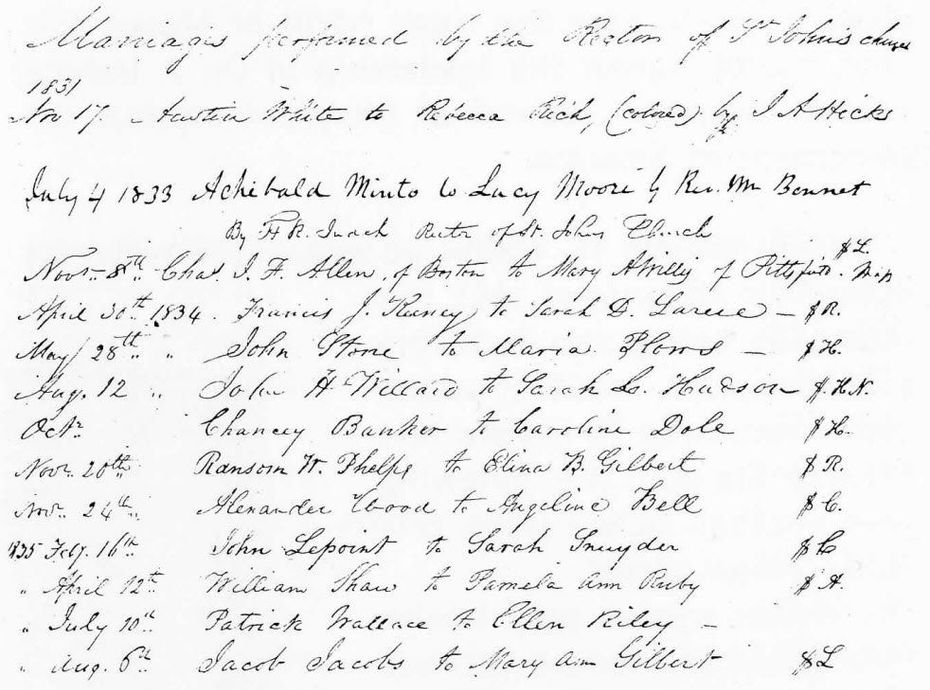
The earliest marriages as recorded in the parish register.
Hicks resigned at the start of 1832 to accept the rectorate of Trinity Church, Rutland, Vermont. He later joined the faculty of Vermont Theological Seminary. Apparently the struggling congregation offered little inducement to a rector and the first three choices refused. In October, Herman Hooker, a deacon who had been assisting in the parish, accepted the post. Bishop Onderdonk ordained him the following May 13 at St. John’s. Undoubtedly Hooker’s greatest service was his formation of an adult Sunday School. In September 1833, after less than a year as rector, Hooker resigned.
Rev. Henry R. Judah of Bridgeport, Connecticut replaced him. Judah was considered to be a gifted preacher and a conscientious pastor but little else is recorded of his three years as rector.
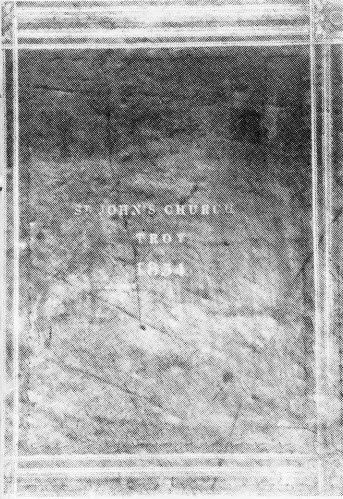
The cover of the Prayer Book acquired in 1834.
It is the only surviving relic of of the early history
of the church aside from the parish register.
Francis Mann secured a $1,000 gift from Trinity Church, Wall Street, to pay off the parish’s debt in 1835. Trinity Church had a long history of assistance to struggling young parishes and had earlier contributed part of the money used to construct the church building. As a condition of its gift, Trinity’s vestry insisted that St. Paul’s forgive the $2,000 still owed for the structure. Judah resigned the pulpit in 1836 to return to Connecticut but contracted a cold during the move and died in Troy. His son Theodore later returned to Troy to study at Rensselaer Polytechnic Institute and went on to a distinguished career as an engineer and promoter of the Central Pacific Railroad.
Judah was followed in September 1836 by Rev. Gordon Winslow who seems to have been in continually poor health and resigned after a year. It is during this period that Emma Willard organized support for a missionary school in Athens, Greece. She apparently enlisted the support of many of the women of the church but there is no surviving evidence of the mechanism.
This is probably a good place to mention the contributions of Mrs. Willard to the church. Not only were her black dress and white mull turban a common sight at St. John’s since its founding but she insisted that her students attend. They constituted a large portion of the congregation and much of the choir. The Seminary’s music teacher seems to have also served as organist. Indeed, the earliest recorded organist at St. John’s was Jane Porter Lincoln who was Mrs. Willard’s niece as well as a teacher at the Seminary.
Mrs. Willard, who had been a widow since 1825, married Dr. Christopher C. Yates at St. John's on September 17, 1838. She transferred the Seminary to her son John Hart Willard (who was also married in St. John’s) and accompanied her new husband to Connecticut. The marriage failed and in 1843 she secured a divorce from the Connecticut legislature.
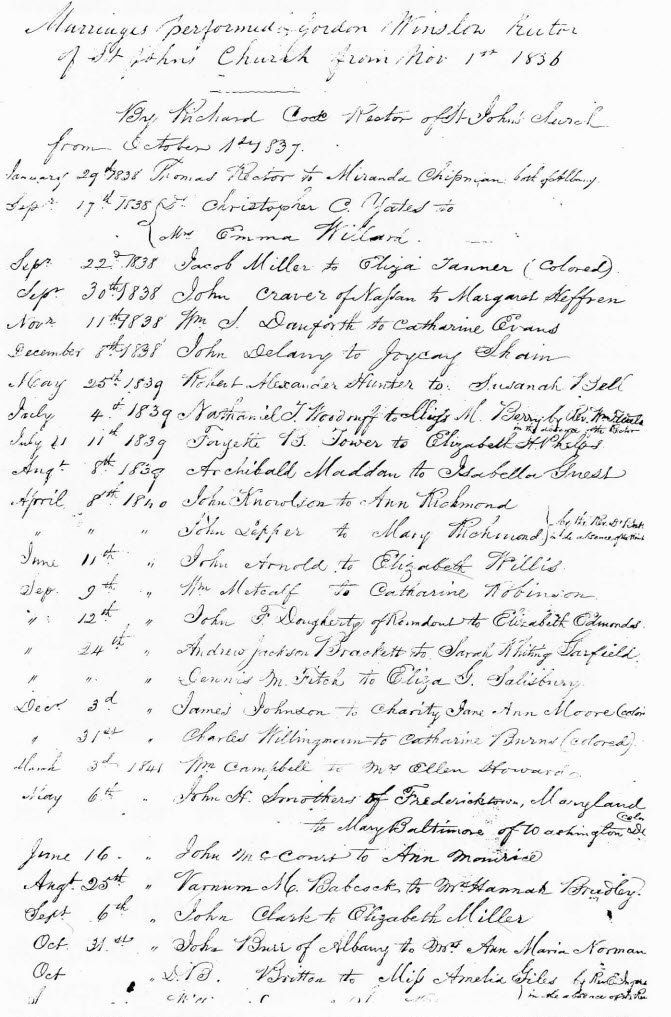
Emma Willard's marriage as recorded in the first parish register.
Rev. Richard Cox replaced Winslow as Rector in October 1837. During his leadership substantial physical improvements were made in the church. In what must be one of the earliest examples of a matching grant James Van Brackle in 1839 left the church $500 for improvements to the bell tower and a new bell, provided the money was matched by the congregation. Before investing the money in the old building the vestry discussed moving the church closer to Washington Square. A committee appointed to consider the move recommended against it.
Instead during 1840 about $2,000 was spent in renovating and repairing the existing building. A tall steeple was added to the bell tower. Two years later the bell was recast, acquiring a notedly pleasing tone. The Van Brockle legacy involved the church in a decade of problems because the executor divided the estate before he realized that there was an unborn heir. He had to ask the church, as well as other beneficiaries, to return part of its money. The vestry, not wishing to be stampeded, waited until July 1849 before giving a note for the excess money and interest.
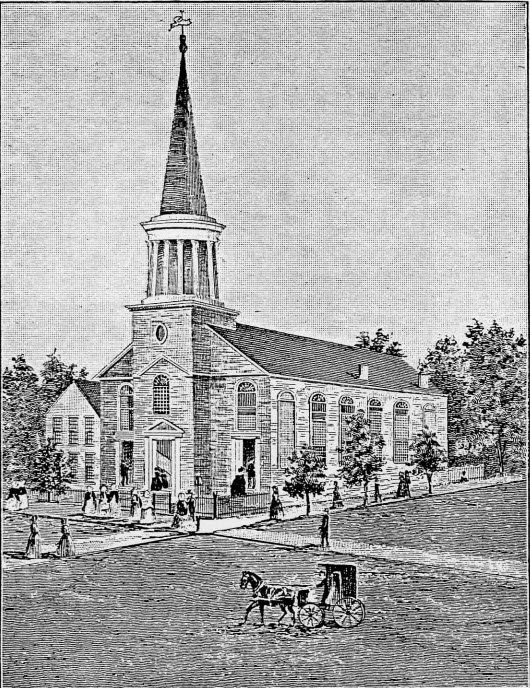
St. John's as reconstructed in 1840.
Cox resigned in May 1844 to accept a call from Zion Church in New York City. During the seven years that Cox led St. John’s it became a stable organization with 151 members and an adequate budget. Apparently Cox retained strong friendships in Troy for he was invited back in December 1848 to assist in the consecration of the Church of the Holy Cross which the Warren family built on the corner of their estate atop the ridge north of Mount Ida. That church, under the leadership of Dr. J. Ireland Tucker, became a center of liturgical musical development in America.
Rev. William H. Walter accepted the rectorate during the summer of 1844. His increased salary resulted from a subscription, most of which came from John H. Willard and Francis Mann. The following year another subscription provided a new carpet.
Walter was in poor health throughout his tenure yet was described as “a fervant and persuasive preacher, a faithful pastor, diligent in study, accomplished in manners.” His failing health forced his resignation in April 1845 and he died the next month at the age of 36, genuinely beloved by the congregation. Evidence of that regard can be found in the plaque lovingly moved from the old building which decorates the bell tower.
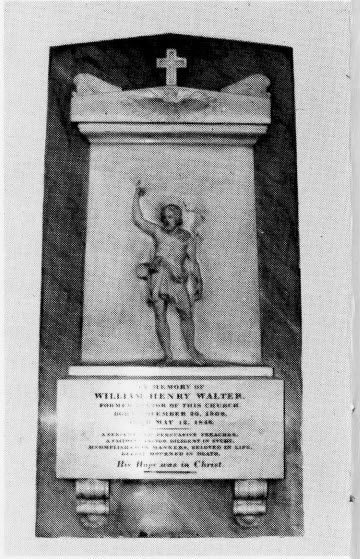
The plaque in memory of Rev. William H. Walter
is one of only two to clergymen in the church.
The other honors Rev. Henry R. Freeman.
On May 30, 1846 Rev. Abraham Beach Carter, who had earlier served as supply, began his term as rector. His $1,000 per year salary in 1846-47 is the earliest of which we have a record. Carter found St. John’s not to his liking and resigned on September 7, 1847 to accept “ a position, which may afford me greater chance of usefulness in my profession.” Where that greater usefulness was is uncertain. Carter's successor was Rev. Edward Lounsberry who preached his first sermon in September 1847. Interestingly, Lounsberry was paid only $800 during his first year. This apparently reflects the financial problems which confronted the parish during the late 1840s. Even in its reduced circumstances St. John’s contributed $107 to the relief of starving Scots in 1847. It was part of a nationwide campaign to supply food to Irish and Scotch areas devastated by crop failures.
Colonel William T. Willard, the parish treasurer and no relation to Emma, reported on October 7, 1848 that the parish owed $1,814 to various individuals including organist Jane Porter Lincoln who had not been paid since 1846. He listed the parish’s income as only $1,200 in 1847 and the value of its property as $16,035. Undoubtedly the latter was high since the church building sold two years later for $6,000 less than his estimate of its value. Willard’s report showed that the rector still received $800, the organist $50, and the sexton $100 per year. Operating costs seem miniscule by modern standards: fire wood cost $5.75 per cord and a ton of coal could be bought for $6.00.
Under Lounsberry’s leadership St. John’s regained its financial strength and increased membership. In 1849 the vestry, apparently prodded by the rector, negotiated an agreement with St. Paul’s which voided the “buy-back” provision so long as St. John’s within three years purchased land between Congress and Hamilton Streets worth at least $4,000 and built on it a church costing at least $15,000. St. John’s also agreed that a condition of the sale of the old building would be its demolition. Even so, the vestry hesitated to construct a new church. The issue came to a head on May 31, 1849 when Lounsberry demanded that they act. He restated his belief in the importance of a new building which he insisted could be built for $17,000 or $15,000 without spire or basement. The rector argued that the old building could be sold for $10,000 and that since the church had $19,000 in hand there was no financial obstacle. He reminded the vestry that one of the reasons for the growth of the congregation was the expectation of a new building and complained that the failure to act had caused a decline in interest and zeal during the last two months. Moreover, he feared that if St. John’s did not move into the southern section of the city other churches would. The vestry was unmoved.
This dispute with the vestry and personal problems sapped Lounsberry’s strength. On September 23, 1850 he penned a long letter in which he recalled that he had taken over an “enfeebled and distracted parish” and lamented that his leadership had “often been a halting and imperfect one” because of his health and personal problems. Yet he was not dissatisfied with St. John’s although “deeply tried and disappointed by the vestry’s refusal to go on with a new church.” The rector then asked for, and received, a leave of absence for a year. Rev. John West served as temporary replacement between September 1850 and March 1851.
By the end of 1851 church finances had greatly improved and the following May the first large donations for construction of a new building appeared. Francis N. Mann subscribed $3,500 while Emma Willard and her son added another $1,875. The gifts were in anticipation of the sale of the church building to Gardner W. Rand who on July 8 formally agreed to purchase the structure for $9,000. He undertook to dismantle the ediface within 60 days and permitted St. John’s to keep the “Monument in the Walls” to Walter and the cornerstone. Title was exchanged March 14, 1853 and Rand Hall (later Rand Opera House) soon arose on the site which it occupied for over a century.
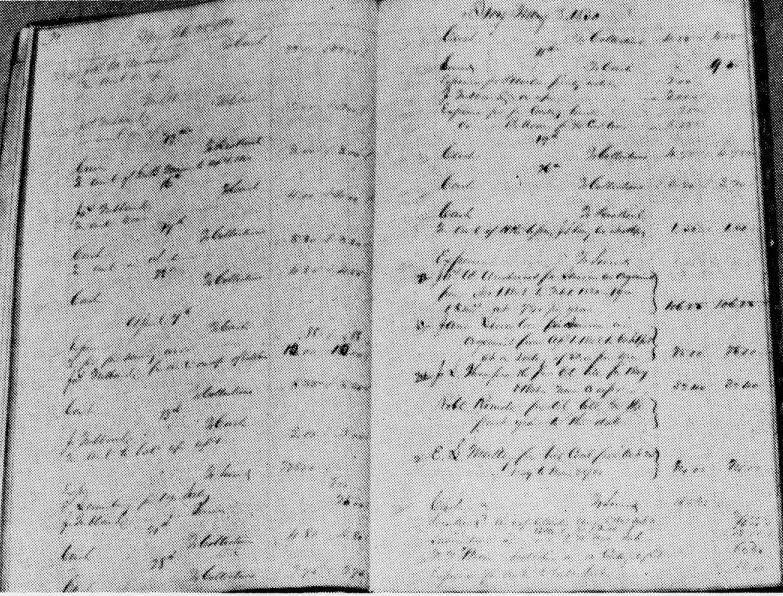
The parish account book for 1850. Note the payment to Jane Lincoln of her back pay as organist.
By July the vestry had purchased two lots on the east side of First Street at Liberty from Dennis N. Fitch for $3,600. Fitch was a vestryman who had acted in behalf of the church in acquiring the lots. They formally became the property of St. John's on February 10, 1853.
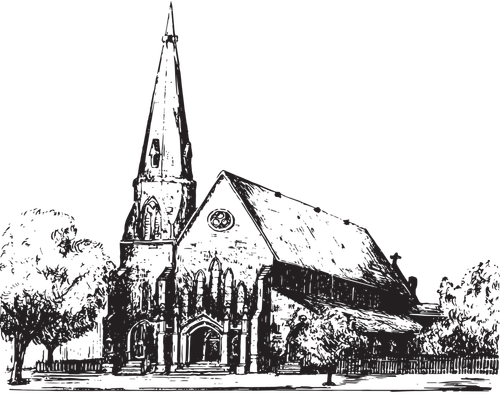
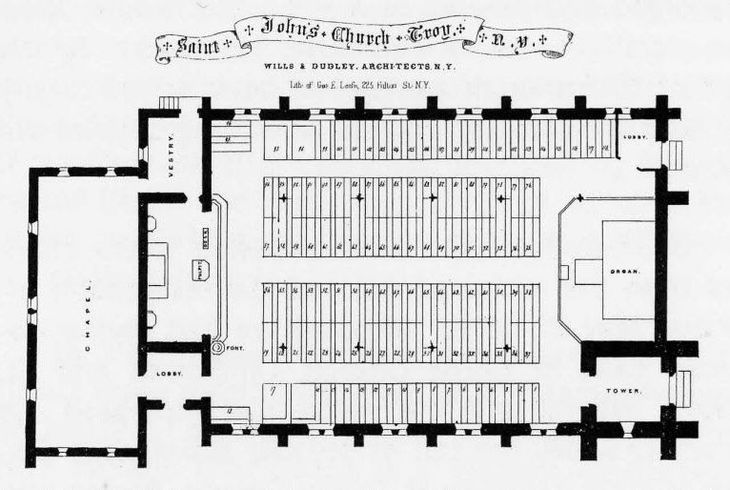
Now that the site had been arranged, the vestry contracted with Wills and Dudley (later Dudley and Condit) of New York for the design of the church. The result was a Gothic revival building similar to many English country churches, or as the Troy Whig described it “early English style.” It was the work of Henry Dudley. The nave measured 100 by 62 feet, the chancel 10 by 27, and the chapel along the east end was 50 by 21 feet. The building had a full but shallow basement. The “Connecticut Stone” or brown sandstone used in the masonry work came from the Shaler and Hall quarry in Portland, Connecticut. The structural framing used the best quality western white pine while butternut was chosen for all joiner work and the pews. The columns which supported the ceiling vaulting were built up of Caen stone while the ceiling itself was painted a cobalt blue with buff and white stenciled borders. A three foot high organ platform jutted out from the middle of the west wall and contained a new organ with 39 stops purchased by George M. Tibbits from W. B. D. Simmons & Company of Boston for $2,875.
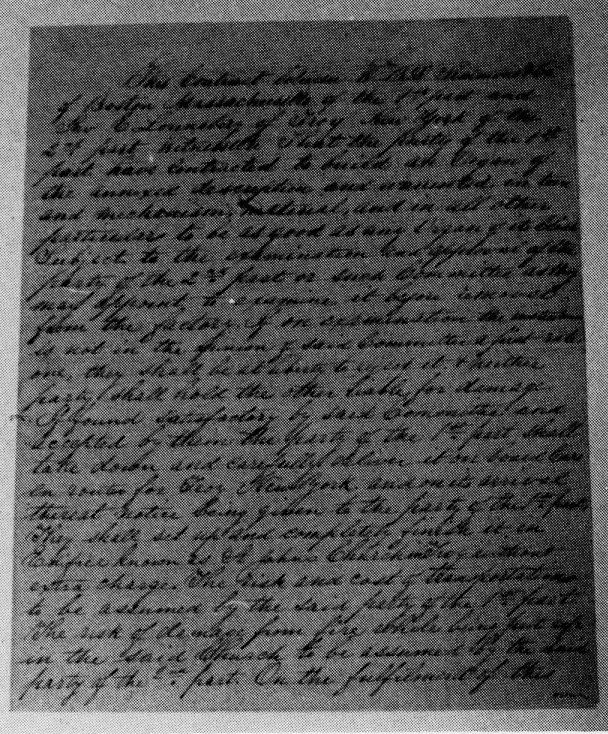
The contract with W. B. D. Simmons & Company for the organ installed in the new church.
Specifications for the building called for Welsh slates on the roof and a cast iron cross atop the spire. The windows by Doremus & Ackeroyd of New York City were plain and adorned by foliage borders, except for the circular one in the front gable and five small lancet ones below. The layout of the church would seem unusual today with the organ and choir in back and no center door, a center pulpit, and shallow chancel. The completed building cost about $50,000.
Provisional Bishop Jonathan Mayhew Wainwright laid the cornerstone on June 18, 1853. While the construction took place the congregation worshipped in the chapel at the Female Seminary. Mr. Lounsberry did not remain to see the building completed. In March 1854 he accepted a call to St. Jude’s Church, Philadelphia “on account of a great sorrow which had come to him in his family” to quote one of his successors, referring to the recent deaths of his wife and two infant children. Clearly a strong personality, Lounsberry forced the building of the church and increased the size of the congregation by 147 members despite the departure of many parishioners for the west.
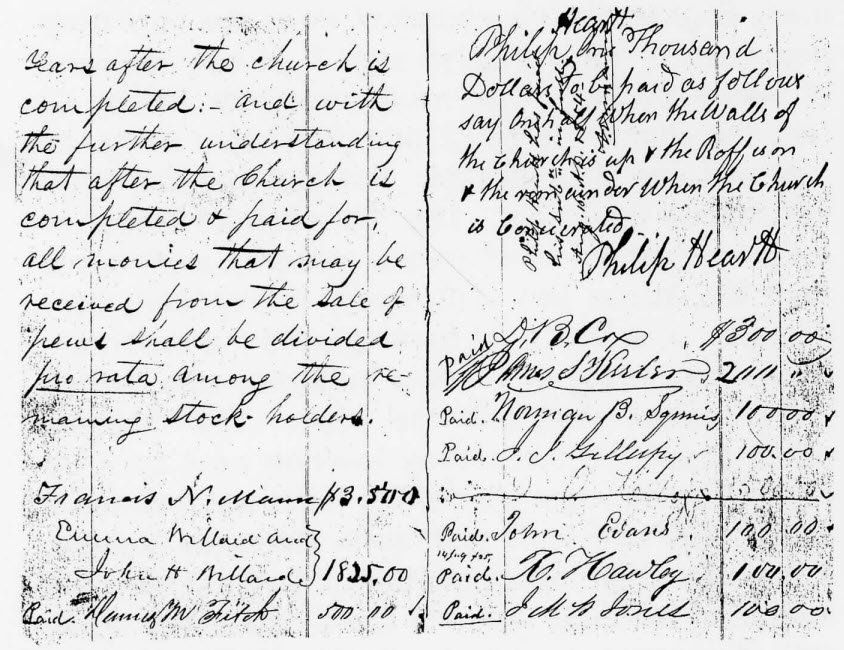
Two pages from the subscription book for the building of the new church.
In June 1854 Rev. Richard Temple responded to the call of the vestry. He started work the following month. No sooner had Temple arrived than one of Troy’s periodic fires threatened to destroy the unfinished church. On August 25, 1854 a major conflagration devastated the area between River and First Streets from Division to Jefferson. While the flames themselves did not reach St. John’s, a windblown brand crossed the street to lodge in the timbers of the unfinished steeple. An onlooker, James Stantial, climbed into the framework and dislodged the ember before it spread its contagion.
George Washbourn Morgan, the organist at Grace Church, New York, inaugurated the dedication ceremonies with a concert on May 30, 1855. The dedication of the church occurred the next day. The Provisional Bishop of New York, Dr. Horatio Potter, consecrated the building while his brother Bishop Alonzo Potter of Pennsylvania preached the sermon. The latter was the son-in-law of Dr. Eliphlet Nott the distinguished Presbyterian cleric who served as president of both Union College and Rensselaer Institute. Two former rectors, Richard Cox and Edward Lounsberry, returned for the festivities. It must have been a particularly satisfying experience for Lounsberry who had struggled so hard with a reluctant vestry to secure the striking new building. Most of the furnishings, including a “New Jersey free stone” font, were new but no details have survived.
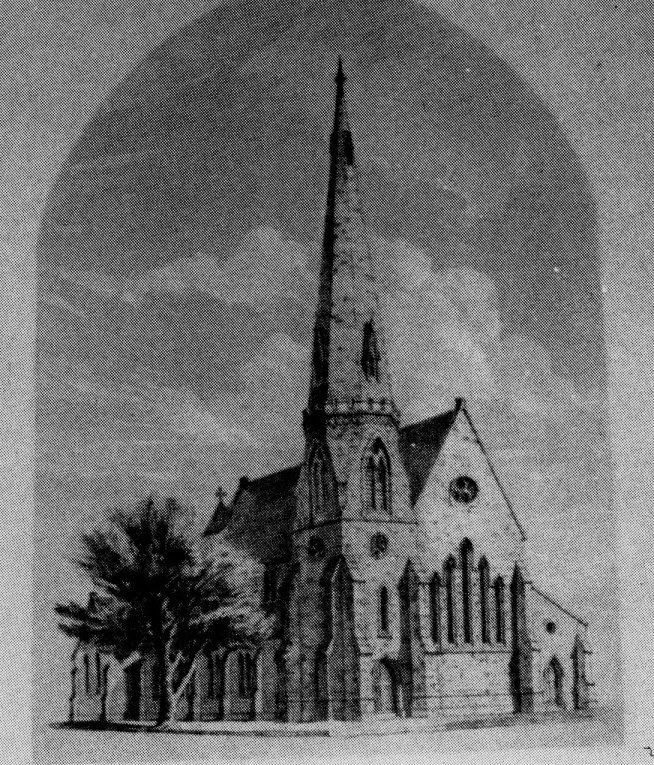
St. John's as it appeared in 1855. The tree was a famous one under which the log cabin
symbol of William Henry Harrison had been built during the 1840 presidential campaign.
A week later pews were sold and among the purchasers were Mann, Tibbits, Emma Willard, Mayor Elias Plum, Norman B. Squires, and John W. Dauchy. If the surviving records are accurate the early months in the new building went smoothly although the rector’s health deteriorated. In September 1856 he resigned.
Rev. J. Brinton Smith arrived from Philadelphia in December to replace Temple. Smith’s rectorate brought a further growth in the size of the parish. Physically, the most striking and lasting improvement was the gift in 1858 of a new steeple by Mrs. Almira Hart Lincoln Phelps, Emma Willard’s sister and long time second-in-command at the Seminary. The steeple was a memorial to Mrs. Phelps’ daughter Jane Porter Lincoln, a long time parishioner and early organist. The money was that received by Mrs. Phelps from the New Jersey Railroad following her daughter’s death and her severe injury in a railroad accident in August 1855.
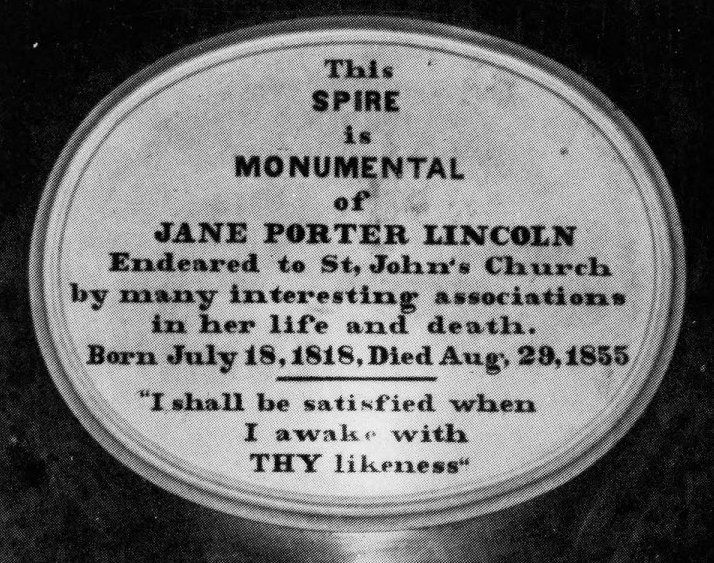
The memorial plaque of Jane Porter Lincoln.
Smith, who had been injured in an accident soon after his arrival in Troy, resigned in February 1859. Three months later Rev. Henry Codman Potter arrived as rector. He knew the church and Troy well, having been born in Schenectady in 1835 as the son of Bishop Alonzo Potter who had preached the dedicatory sermon for the church. Educated at Virginia Theological Seminary, young Potter had been ordained the preceding fall.
During his eight years at St. John’s Potter demonstrated his interest in the young adults of the parish and his strong belief in the responsibility of the parish to minister to the whole individual. Not only was he a national leader of the Young Men’s Christian Association but he led his parishioners into active Christian work. In the process he unified a deeply divided group. We do not know what caused the divisions but there is a tradition that the vestry did not meet for several years because of the depth of feelings between some of its members. Those divisions do not appear in the sermons which he preached on the thirtieth anniversary of the parish.
The Potter years saw continued improvement in the parish’s size and financial strength. The debt on the new building was discharged by 1859 through the efforts of Mann, John H. Willard, and Henry Robbins. It was a youthful parish. Potter later commented that: “There were few gray heads in St. John’s when I came to it, or left it.” But, he added, “the young blood kindled into a common enthusiasm as we worked together.” Those years brought physical changes to the church building. Running water arrived and during 1862 some of the rear pews were altered from slip to square.
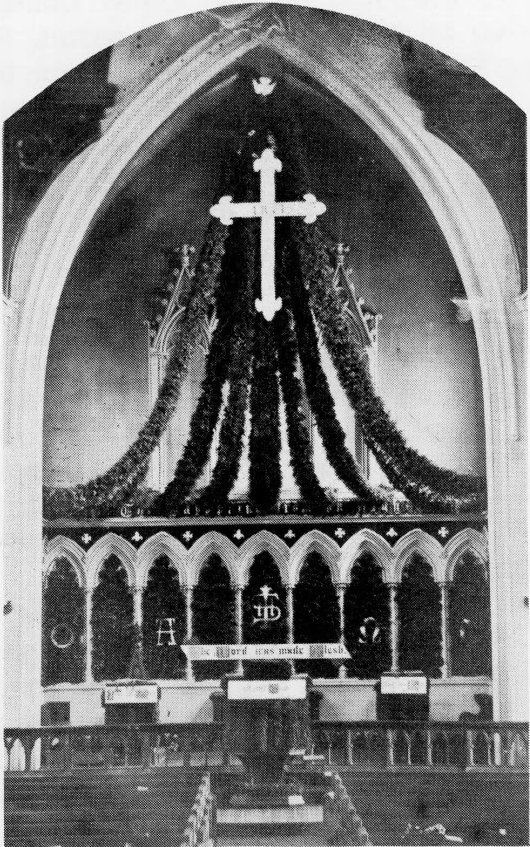
The chancel decorated for Christmas, 1862. The center pulpit and shallow chancel are both very clear.
Even the church could not avoid the overwhelming presence of the Civil War. Although few parishioners can be identified among those who served at the front, some had outstanding records. The best known was William B. Tibbits who raised a company after the attack on Fort Sumter and a regiment of cavalry in 1864. He distinguished himself on the battlefield, rising to Brigadier General in the last days of the conflict. Potter himself visited the battlefield at Gettysburg immediately following the battle and returned to preach a sermon on “Succor in the Plague” from the text of Numbers 16:45: “He stood between the dead and the living; and the plague was stayed.” The sight of the carnage of the battlefield made him physically sick.
An indication of the wartime affluence of Troy and St. John’s appears in the 1863 decision to build a rectory. Heretofore, the rectors had rented various houses. Accordingly the church purchased a lot on the northeast corner of Washington and First Streets for $1,125. The rectory cost $9,011 and was largely paid for with a legacy of $4,000 for that purpose from Mrs. Sarah Bradley and $4,417.75 raised by subscription. Another aspect of the availability of money was the support given the choir. The two leading members were paid $200 per year while two others earned $75 and one $50. When the opportunity arose in 1864 to hire a Miss Phoebe Pierce a special subscription raised $205. In the era before the formation of the boys choir the church relied upon a small group of professional singers, normally a quartet or a sextet.
The interior of the church before the raising of the organ and choir in 1864.
By 1864 several church activities had outgrown their allotted spaces. When consulted, Dudley estimated that it would cost $3,000 to add a two story addition to the chapel or $2,000 to extend the transept southward. Both exceeded the resources immediately available but during the summer a plan evolved to relocate the communion rail and raise the organ and singers to a loft. This would allow the installation of an additional 100 seats. By the end of 1865 enough money had been raised to pay for both the changes and the remaining debt on the rectory.
Scarcely had the church adjusted to the changes than the rector announced his resignation effective May 29, 1866. Although he had earlier declined calls to Christ Church, Cincinnati and St. Paul’s, Albany and the vestry had increased his salary to $3,000 the call to become assistant to Bishop Manton Eastburn at Trinity Church, Boston was an opportunity he could not refuse. Potter’s term was one of the most successful in the history of the parish. He built upon the strong foundation left by Lounsberry and Smith to bring in new people, especially the young, and make the members an active congregation. Soon after his arrival in Boston, Potter became Secretary to the House of Bishops. In 1868 he transferred to New York as Rector of Grace Church and 15 years later rose to Assistant Bishop of New York under his uncle Horatio.
At Potter's last vestry meeting Alfonso Bills, one of the senior vestrymen, pointed out the need to add new blood to the parish's leadership. He suggested that two members of the vestry decline reelection annually until all except Judge Mann had been replaced. The proposal lost as did similar efforts in 1934, 1947, 1971, and 1979 to legislate rotation among the parish’s leadership.
The search committee charged with finding a replacement for Potter had a difficult assignment. The first two men they approached declined to come. In May 1866 some members of the committee heard Rev. George Herbert Walsh reach in Rhinebeck. They reported that they were “much pleased with him, but think it is very doubtful whether he would accept a call.” But he did, assuming his duties during July 1866.
Walsh intensified the support of missionary activities. In 1867 he secured the formation of a Missionary Society which three years later changed its name to the Parochial and Missionary Society. It collected and disbursed money to domestic and foreign missions. The following year a group of women moved in a different direction by forming a Mother’s Meeting to sew clothes for the needy of the parish. That Christmas Eve they also staged a “liberal entertainment” in the chapel for the unfortunates. It appears not to have been repeated. During 1869 another missionary organization started, the Ministers’ Aid Society which employed poor women of the parish to make clothes and household items for the poorly paid missionaries and clergy in struggling parishes.
Five years later, in February 1874, a group of the younger men formed a Guild of St. John’s Church to cultivate the spirit of Christian fellowship. The Guild undertook to welcome strangers to the church, visitations to non-church goers in the district, sick and poor relief, study of music, church decoration, and the parish library. At about the same time a Parish Missionary Society started which raised $3,000-4,000 per year for distribution by an elected Executive Committee. By 1878 two more organizations had appeared. The Saturday morning Sewing School taught young ladies of the parish sewing while the young ladies of the Sunday School formed a group they called The Tegulae to raise funds to tile the chancel floor.
The 1860s saw the start of St. John’s direct involvement in missionary efforts in Troy and its vicinity. Early in 1865 pressures developed to establish a mission among the iron workers in south Troy. The nucleus of the new congregation began worshipping in the Mechanics Hall on Mill Street. Late the following year both St. Paul’s and St. John’s agreed to support the new parish which acquired ground for a church at First Street and Burden Avenue. The building of the new church, St. Luke’s, was completed in 1868. Members of St. John’s contributed $6,000 towards its construction and the parish made annual contributions until 1886.
On February 14, 1868 Walsh organized the St. John’s Free Mission with a Sunday School held in a room at the Ida Hill Cotton Mill. In 1871 the Mission moved into its own building opposite the Mount Ida Falls. While Walsh, and after 1870 his assistant Rev. James Caird, provided leadership for the Mission, the funds for the church building were contributed by Franklin W. Farnam, a communicant of St. Paul’s. The Mission became independent as the Free Church of the Ascension on January 1, 1873 with Caird as rector.
The third major missionary effort started as that on Ida Hill drew to its successful close. In 1872 St. John’s undertook assistance to the mission Church of the Epiphany in East Albany (Rensselaer). St. John’s not only contributed to the support of the mission but Walsh acted as its overseer between the resignation of its founder Dr. L. P. Clover in July 1874 and the appointment of Rev. Richard Temple, the former rector of St. John’s, in October 1875.
The 1864 raising of the organ and choir to the loft proved less than happy. Within four years the vestry authorized moving the organ to “some more suitable situation” along with redecoration of the building and other improvements. Nevertheless, when the church was redecorated and new carpets laid during the summer of 1869 the organ was left in place, probably because a more suitable location could not be found. Another improvement literally made itself heard on September 11, 1870. That day Peter McGoldrick of Albany played the newly installed chime of 11 Meneely bells for the first time. Each bell had been the gift of a different individual or group*. McGoldrick played a concert of 15 tunes beginning with Changes on Eight Bells and including Old Hundred, Hail Columbia, Blue Bells of Scotland, Yankee Doodle, Last Rose of Summer, and ending with Home Sweet Home.
*No. 1, Judge Mann; No. 2, Miss Sarah B. Tibbits; No. 3, Sunday School; No. 4, Elizabeth Jermain, Isabel, and Walter Cox in memory of their brothers and sisters; No. 5, William A. Thompson in memory of Clarkson Crosby Thompson; No. 6, Norman B. Squires in memory of Mary W., Norman H., and Jeanie S. Squires; No. 7, Marie Kate Young and Jennie M. Sims; No. 8, Julia Louise Babcock; No. 9, Fannie Southwick Tillinghast; No. 10, Alice Griffith Tillinghast; No. 11, Infant Class of 1870.
Smaller gifts, no less lovingly presented nor less necessary than the large ones, also appeared. At Easter of 1869 the ladies of the parish presented a silver communion service. Inadvertently sold, part of the service was reclaimed in 1975 by the then rector, Rev. Frederick C. McQuade. In 1871 Mr. and Mrs. John H. Willard contributed the baptismal font which is still in use. Three silver alms basins made by Tiffany & Company were given in 1887.
In December 1868 the Northern Convocation of the Diocese of New York became the Diocese of Albany. It is an indication of the Anglo-Catholic leanings of the diocese that it was the first in the United States to take the name of its episcopal seat. When the voting came for selection of a Bishop the St. John's delegation found itself in the minority when William Croswell Doane was elected. Since the opposition to Doane generally derived from his espousal of the Oxford movement this reflects another example of St. John’s “low church” heritage. Two years later Treasurer Thomas A. Tillinghast refused to pay the parish’s assessment for the Bishop’s salary because of the strength of feeling at St. John’s over the enactment of a canon giving the Bishop a veto over appointment of clergy. It must have been somewhat of an embarrassment to Tillinghast who was a member of the Diocesan standing committee. The boycott continued until 1872 when the vestry agreed to pay provided no money be included from individuals who stipulated it not be so used.
Not until 1887 did the Diocese become so administratively complex that it had to be divided into four conventions, or as they are now called Deaneries St. John’s was one of the two “moderately well-to-do” parishes which led the Troy segment. Over the years, St. John’s has been active in the Deanery and many of its parishioners and clergy have held important posts in the diocesan administration.
When the Sunday School petitioned for enlargement of the chapel in 1873 Warden Norman B. Squires pointed out that there were no Bible Class rooms nor a suitable library; moreover, the church and chapel steps were very inconvenient for the youngsters of the Infant School. The vestry established a committee to recommend improvements. In July Tillinghast, for the committee, presented a plan for the enlargement of the chapel drawn by the Troy architect Mark F. Cummings. He proposed extending the chapel to the south lot line to gain rooms for the Sunday School Library, the Bible Classes, and the Infant School. Cummings estimated that the changes would cost $3,500. The vestry sent the matter back to the committee with instructions to include relocation of the choir and organ. Further study indicated that it was inexpedient to move the old organ so the vestry decided to trade it in on a new one but to leave it in the loft. But when the cost of the addition proved to be nearly twice Cummings’ estimate the purchase of the organ was delayed. The addition, completed in 1874, is what we know today as the choir robing room and the old library. After wrestling with the unexpectedly high cost the vestry decided to request additional quarterly payments.
Some idea of the finances during the period can be gathered from the Treasurer’s report which listed income from pew rents as $4,003.19 in 1874 and operating expenditures as $5,687.86. Salaries paid that year were $2,500 to the rector, $400 to the sexton, $900 to O. R. Greene the organist, and $200 to the bell ringer.
Walsh resigned in April 1876 to accept a call to Trinity Church, Bergin Point, N. J. Like most of the early rectors, he seems to have been concerned about Troy’s unhealthy climate which was a combination of the hard winters, river valley miasma, and atmospheric pollution from the nearby mills. In July the vestry chose Rev. Frank L. Norton of Longwood, Brookline, Massachusetts who took up his duties in November. The growth of the parish and its financial strength allowed Norton to employ an assistant. Rev. George F. Breed, subsequently Rector of Trinity Church in West Troy, served in 1878-79 and was followed in 1879-80 by Rev. William Morris Barker, later Bishop of Olympia, Washington. Norton founded a parish newspaper, The St. John's Tablet , which flourished until 1890 as a source of parish news and a vehicle for florid late 19th century religious writing. During Norton’s years the choir enjoyed a Renaissance although the turnover of directors was extremely high. The Tablet in December 1878, for instance, noted that Leonard Paige, “one of the few pure tenors in this part of the country” had been hired for $500 per year and that a Mrs. Wilson had been engaged as a soprano. A professional chimer played the bells. From about 1874 until early 1879 it was John Waters. He was followed by Edward H. Holliday (1879-82), William Kane (1882-86), Jesse R. Fenton (1886-94), George Murray (1894-1902), and the long tenured J. Harvie Purdy who held the post until professional chimers were dropped in 1922.
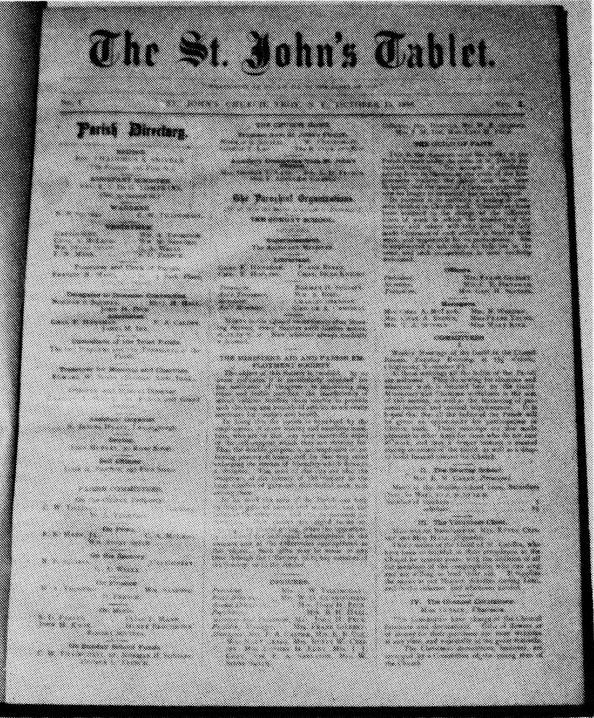
The first page of the early issue of The St. John's Tablet. Both Revs. Frank Norton
and Thaddeus Snively used it is as a means of communicating with their parishioners.
Some sense of the care taken in decorating the church for festive occasions can be gained from the description in the Troy Morning Whig of the preparations for Christmas in 1878. In the chancel “evergreens curved gracefully down from the ceiling, and in the midst of this embowry swung the great Christmas bell . . . the dosel . . . of a white backpanel . . . [with] a cross of dark green ivy, dotted with holly berries, the arms of which were encircled by a wreath of the choicest white flowers." Palm branches decorated either side of the chancel while two vases on the retable held bright flowers. The chancel rail was bound in evergreen while orchids hung in front of the pulpit. Evergreen festoons swung from the apex of the roof to the capitals of the columns.
The Infant School presented a pair of windows which were installed under the organ loft. Apparently most of the money for the windows came from Mrs. Thomas A. Tillinghast. The addition of the windows coincided with installation of the long discussed organ. It was used for the first time during the Easter Service in 1879. The organ drew its power from a “water engine” and cost slightly over $4,100 installed. Most of its cost was borne by a special subscription of which Mrs. George M. Tibbits and Francis Mann were the principle contributors.
During the spring of 1879 a special collection raised $2,500 to endow a bed at Child’s Hospital in Albany. The money paid for St. John’s House in return for which the hospital agreed that the church “shall always be entitled to and have a bed for a patient.” A similar endowing of a bed at Samaritan Hospital in Troy occurred in 1913.
Francis N. Mann died February 8, 1880. He had been a founder of the parish and had served as Warden since 1840. Mann bequeathed the church $25,000 to endow its benevolent and charitable activities. It was the largest gift yet received and, at the time, was said to have effectively endowed the whole educational and benevolent activities of the parish. In his will Mann requested that a series of seven discourses be delivered by the rector on successive Whitsundays:
- The relative duties of minister and people as co-workers in Christ’s Church;
- The prayer of the faith;
- Public service in the church;
- Charity;
- Baptism;
- Confirmation;
- Holy Communion.
Charles W. Tillinghast replaced Mann as warden in a shift which reflected the changes that had taken place in Troy during the preceding 30 years. Troy’s initial leadership had been merchants who developed a substantial regional market but found their efforts to expand stifled by the Erie Canal which diverted western trade to Albany and New York. The Erie and Champlain Canals, however, hastened the second era of Troy's development by allowing the easy movement of Adirondack iron to the factories which rapidly sprang up along the Hudson and up the Wynantskill. Notable among these establishments was the stove works of J. M. Warren and Company, of which Tillinghast was a founder and the complex of iron and later steel mills which ultimately combined into the Troy Iron and Steel Company of which Tillinghast was a director.
Very few early sermons have survived. One of which we have a copy is that preached in May 1880 by Norton on “Christian Knighthood" at a gathering of the Troy Citizens’ Corps, a militia unit. He praised them for their service during the labor strikes of 1877 “when rebellion lifted its hydra-headed front in that contest between labor and capital, or rather between lawlessness and constituted authority, growing out of trades’ unions and disgraceful strikes.” The service began a tradition of military, and later police units attending special services in their honor at the church.
Shortly after preaching the sermon Norton sailed for a vacation in England. There he was visited by the jurist and diplomat J. C. Bancroft Davis who convinced him to accept a call to St. John’s Church on Lafayette Square in Washington, D. C. Although the offer would have been difficult to refuse under ordinary circumstances, concern about Mrs. Norton’s health played a major role in the decision. Nevertheless, Norton returned to the area in 1883 as Dean of the Cathedral of All Saints in Albany.
The church was closed during the summer and fall of 1880 while the interior was redecorated according to the plans of a Mr. Stent of New York. Among the changes were a painting of St. John on the east wall installed as a memorial to Miss Lillian Burdett from her parents, and the installation of an English tile floor in the chancel as a gift from The Tegulae. Mrs. Cicero Price contributed a carved wooden lecturn and a brass communion rail; Mr. and Mrs. Uri Gilbert added a heavily carved chancel chair in memory of their son Joseph. The most striking gift, however, was a polished brass pulpit which W. Stone Smith gave in memory of his wife. The floor tiles, lecturn, and chancel chair are still in use. The pulpit which duplicated one in St. Stephen’s Church, Philadelphia was transferred to the parish house in 1916 and given to St. Luke’s in 1931. The church reopened in October 1880 with a service at which the “low-church” Bishop of Central New York, Frederick D. Huntington, preached. Two years later Stent redecorated the chapel.
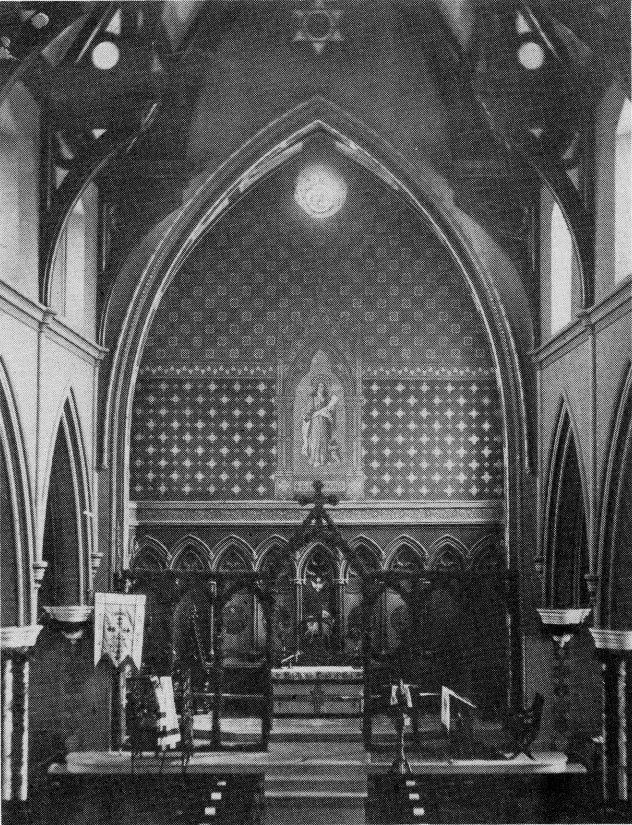
The chancel as it appeared after the 1880 redecoration. The photograph was probably
taken at Christmas 1887 to illustrate the newly installed chancel screen.
In February 1881 Rev. Thaddeus A. Snively accepted the call to St. John’s, beginning his service a month later. He promptly reorganized the offerings. Collections on the first Sunday of the month were for the parish poor; the second and fourth for the needs of the parish; the fifth for charities at the rector’s discretion; and specified charities on the third and special Sundays. In May he preached a pair of historical sermons as part of the golden anniversary of the parish. The formal celebration occurred on May 29 and included a hymn written specially for the occasion probably by organist Henry Church, and a sermon by Rev. R. Heber Newton, the rector of Anton Memorial Church in New York.
During 1881 a group of women in the parish formed the St. John’s Industrial Society to furnish systematic relief for the poor and needy. The city was divided into 11 districts with a pair of volunteers responsible for each area. The following year the group changed its name to the Guild of the Faith. Over the years it developed into an umbrella organization, the St. John’s Women’s Guild, whose concerns embraced the Saturday Sewing School for the girls of the parish, the volunteer choir which called itself the Guild of St. Cecilia, the chancel decorations and flower arrangements, visitation of the sick, and the distribution of religious papers.
With the arrival of Rev. Hobart Cooke in February 1882 the parish once again had an assistant. Cooke was followed in rotation by Revs. John B. Harding (1883-84), Henry Macbeth (1884-85), and E. D. G. Tompkins (1885-88). After Tompkins’ departure for financial reasons the parish waited nearly three decades before hiring another assistant.
Men’s organizations found late 19th century St. John’s infertile ground. They formed infrequently and normally expired soon after inception. A good example was the Men of St. John’s organized in October 1886 which briefly considered sponsoring a coffee house in the southern part of the city to offer an alternative to the pervasive saloon but seems to have functioned mainly to devise ushers’ schedules. More useful as a service to the community was the hiring of a full-time parish visitor to relieve the female volunteers of the Guild of Faith. Miss Mary A. Kirk began her rounds of visits to the sick and sorrowing, as well as her investigations of the needy and distressed, early in 1887. She served until her death in 1901. Mrs. William Mower continued the visits until her passing two years later. The project then lapsed.
During 1882 an English glass window was installed by Mrs. James W. Cusack as a memorial to her parents. Mr. and Mrs. A. Clark Fellows contributed a new alms chest and a vessel for the baptismal font. Late the following year the vestry accepted offers of windows from the Mann family as a memorial to Francis N. Mann; George C. Burdett as a memorial to his parents; and from the Tibbits family. In 1888 Mrs. G. V. S. Quackenbush had a window made by Cox, Sons, Buckley and Company installed as a memorial to her daughters. The Plum window was also installed at about this time on the north aisle.
The Hudson flooded in February 1886 and brought church work to a standstill. It is not clear what damage occurred in the church but a more important problem surfaced during the summer. When two of Snively’s children became sick the doctors suspected a contamination which, as the Tablet reported, “led to the finding of a defect which had been causing illness to the inmates for ten years or more.” It was “a terrible source of danger, whose existence was not suspected by anyone, and which was only found by tearing up a large part of the Rectory yard.” Just what the problem was is not explained but it probably involved an undetected cesspool.
The February 23, 1887 Tablet contained an editorial arguing the need for a parish house safe from flooding. As a step in that direction the vestry on July 15 took an option on the property immediately south of the church. A special collection on October 30 raised more than the $18,000 needed to acquire the house and grounds. After considering the house, the vestry decided to delay building a parish house since all non-worship activities except the Sunday School could be moved into the existing structure. A year later the vestry acquired additional land south of the temporary parish house for $7,000.
By the end of 1888 the parish’s finances were good enough to permit the vestry to authorize Robert W. Gibson in New York to prepare plans for a parish house along lines sketched by Snively after visiting 23 similar buildings. These called for a two-story building, 50 by 40 feet, set 80 feet back from the street. It had a large parish hall on the upper story and two smaller rooms on the lower with a cloister leading to the vestry door of the church. Alterations within the church included changing the vestry into a baptistry which opened into both the nave and chancel through arches. The rear rooms of the chapel extension would then become the new vestry, Sunday School library, and staircase. Gibson’s choice undoubtedly resulted from his recent design of the Cathedral of All Saints in Albany.
The decision to move ahead with the parish house coincided with Professor William Pitt Mason’s purchase of the old rectory. Within two years Dr. Mason would join the vestry, the earliest representative of Rensselaer Polytechnic Institute on that body. Since Mason was undoubtedly the most distinguished member of the RPI faculty of that era and an active churchman, his selection was not surprising.
With the $10,000 from Mason in hand the vestry agreed to build the parish house and a new rectory as well as quarters for the sexton. The latter two were designed by G. Edward Loth of Troy. The rectory was a narrow structure, 80 by 30 feet, three stories high in the front and two in the back. Its most striking feature was a notable iron balcony on the north side. The sexton’s house faced a court to the rear of the vestry. The whole complex covered an area 225 feet long on First Street and 135 feet deep which gave it a unity matched by few other churches in Troy. The three new buildings cost $45,000, about $7,500 more than had been subscribed. As a result the projected deepening of the chancel had to be abandoned.
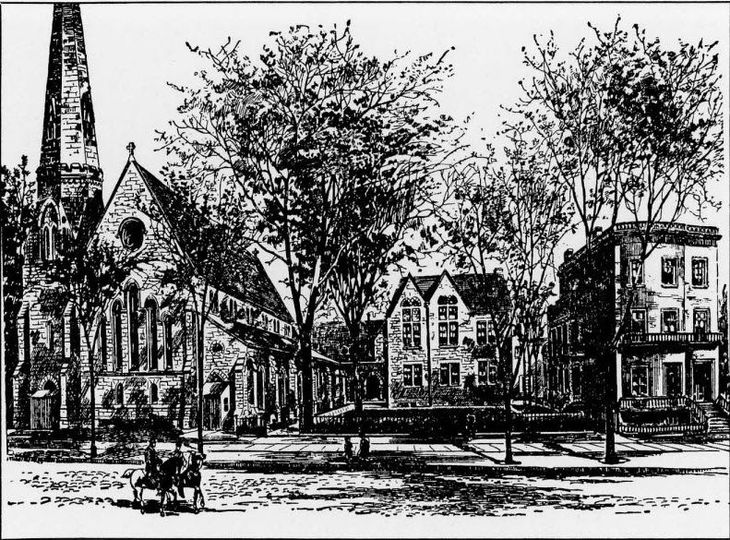
St. John's Complex as it appeared in 1889. The two-story
iron balcony is visible on the side of the rectory.
Snively continued his efforts to involve the younger men of the parish. He arranged with about a dozen of them to take over the ushering on Sundays because it had, in the rector’s words, become “rather languid.” He also assisted in the formation of a chapter of the Order of the King's Sons to undertake general assistance to young men and in the establishment of a chapter of the Brotherhood of St. Andrew which sought to attract younger men to church attendance and other religious duties.
In June 1890 Snively used the Tablet to renew the call for deepening the chancel and to “record our sincere conviction that the greatest defect in our music to-day comes from its position at the rear of the people. At the same time we are equally persuaded that a quartette choir is really an anomaly in our church at the present time.” He argued for a choir of men and boys, supplemented on occasion by women. If women did sing he wished them to appear “as women and not in this newly discovered hybrid costume of the so-called ‘Angelic Choirs’ which . . . is shocking to refined Christian sentiment to-day.” In May 1891 the Music Committee responded with a proposal for a choir of 20 boys, two tenors, two basses, a soprano, and an alto. Such a group, they estimated, would cost $2,225 per year. It would cost an additional $450 to move the organ out of the loft. The new choir started singing in the fall of 1892 but the organ remained in the old location. The two women were dropped in 1896 as an economy measure.
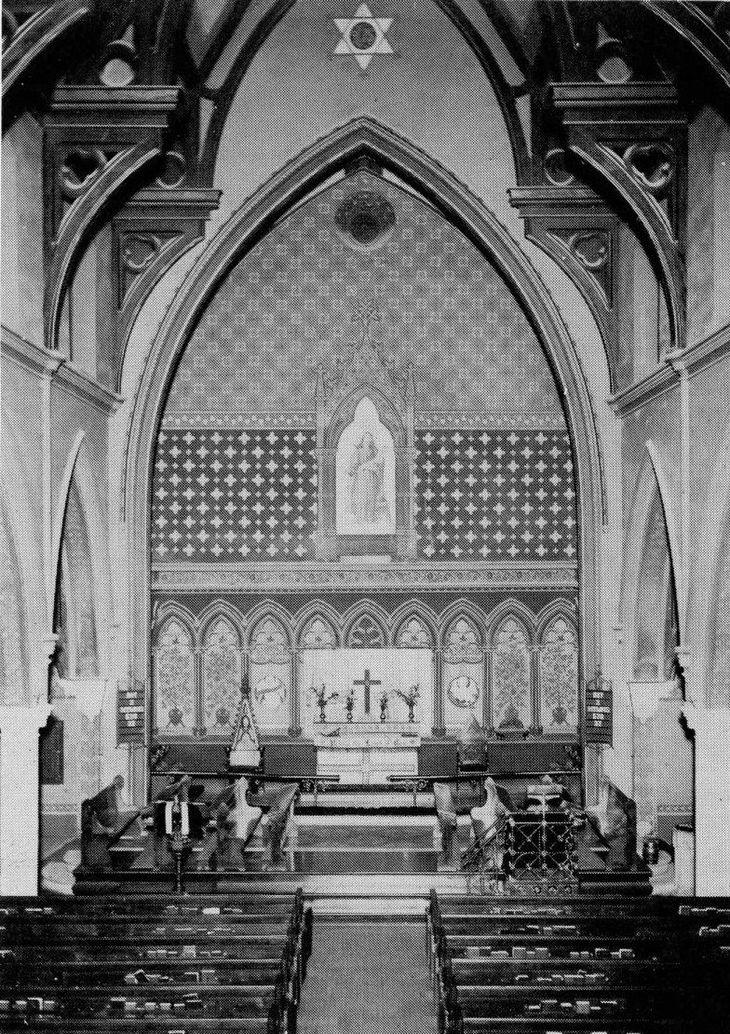
The chancel as it appeared after the 1892 modifications. Note the shift of the pulpit to the
south side of the chancel. In order to permit installation of the platform for the newly formed
boy's choir the first two rows of pews have been removed. Note the pew doors.
Snively did not remain to see the pew choir. He resigned effective June 12, 1892, pointing to the “harmony and especially the renewed hopefulness” which he left for his successor to exploit. The new rector, Rev. Henry R. Freeman, accepted the call on September 1, 1892. His first decade as leader of the parish marked its zenith in power and prestige. If ever St. John’s could claim to be a social church, which is debatable, it was at the turn of the century. In those years it did contain among its parishioners a substantial group of men and women of wealth by Troy standards. As his part in maintaining that image, Freeman insisted upon being called “Dr.” following his receipt of an honorary Doctor of Divinity from St. Stephen’s College.
Freeman instituted a practice of preaching a series of Lenten Sunday evening services centered on a single topic. In 1893 he discussed “Present Day Perils;” in 1894 “The Gospel and the Age;” in 1895 “The New Exodus” and so forth. In 1893 he tried his hand at attracting young men by forming an Association for Men which proved no more lasting than the organizations sponsored by his predecessors. Nor was he more successful with the Young Men’s Association which he organized in 1912. Freeman had more success with the Daughters of St. John’s. They formed in January 1894 to channel aid to the needy and to operate a lending library. The Daughters were the longest lasting organization in the church, later assuming such diverse responsibilities as sewing clothes for distribution by charitable organizations and preparing church suppers. October 1896 brought the organization of the Women’s Guild as the successor to the old Guild of the Faith. It functioned primarily to prepare clothing for distribution by the Parish Visitor.
Freeman added a Church Cadet Corps in 1895. It clearly reflected his lifelong interest in military activities. The Cadet Corps drew about 30 boys in the beginning for drills on Wednesdays but the numbers soon declined and it died. Neither does the Boys’ Club, established the following year to offer recreation and “practical” talks, seem to have attracted much interest. On the other hand, Freeman started St. John’s close connection with the Troy Police Department by serving as its Protestant Chaplain. His successors continued that role which is memorialized by the fence along the Memorial Garden presented by the Police Benevolent Association.
During the late 19th century and throughout the Freeman period worship normally involved a Morning Prayer service at 10:30 and an Evening Prayer at 7:30 every Sunday. Communion was offered at 10:30 on the first Sunday and at 8:00 in the morning of the third one of each month. The adult Sunday School met at 12:15 each Sunday. During the week Morning Prayer was held at 10:00 on Wednesdays and Evening Prayer at 7:30 on Fridays.
In 1896 enough money had been raised to proceed with the long discussed deepening of the chancel. The plans were drawn by Gibson and included a new chancel or east window given by Misses Mary E. and F. Adelaide Gilbert in memory of their parents; an altar and reredos presented by Mrs. Cicero Price in memory of her daughters; and a new chancel rail contributed by Mrs. Charlotte H. Knight and her son Charles Bills Knight in memory of Alfonso Bills. The window, illustrating the Resurrection, was designed by Edward P. Sperry and executed by the Tiffany Glass and Decorating Company. The central lancet depicts the risen Savior descending the steps from the sepulchre; the right one shows Sts. Peter and John; while that on the left contains portraits of the two Marys. The reredos and altar were executed by J. Massey Rhind from designs of Gibson. The reredos is 16 feet high and carved from Caen stone with panels of Carrara marble. The altar is also of marble. The screen is very intricately carved but too tall; it obscures portions of the Gilbert window. The altar rail was also carved by Rhind to a design of Gibson. It was crafted of Caen stone with a marble top. At the same time the Music Committee decided to move the organ and choir into the chancel. Various church organizations contributed new choir stalls. The deepening of the chancel destroyed the chapel so that only the north end, converted to a vestry or sacristy, remained. Mr. and Mrs. Charles W. Tillinghast underwrote the conversion of the former entryway to the chapel into a baptistry. The general design by Gibson was executed by J. & R. Lamb of New York. The most notable addition in the baptistry was an “exquisite representation in glass” of Christ Blessing the Children above the door. A second rendition of Christ Blessing the Children appeared in a window made by Tiffany from a design of Frederick Wilson. It was a memorial to former vestryman Joseph B. Wilkinson given by his wife.
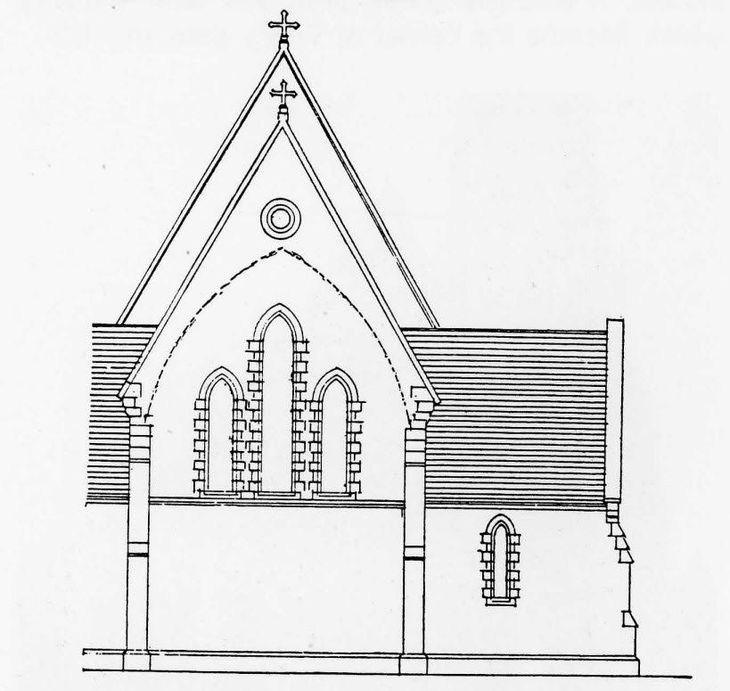
Architect's elevation of east end of the church after deepening of the chancel.
Note the false ceiling in the chancel, indicated by the dotted line.
Among the physically smaller gifts were a credence table executed by Rhind to a Gibson design given by Mrs. John D. Spicer, the long-time directoress of the Infant, and later of the Sunday School; a sedilium from the Misses Gilbert in memory of their brother and sister and a second presented by the Daughters of St. John's; as well as the mosaic flooring under the choir stalls paid for by the Sunday School. A new altar cross was given by C. Whitney Tillinghast II, Alice Griffith Tillinghast Whittemore, and Phoebe Scott Griffith. The alterations cost $18,629 and the refurbished church reopened December 27, 1896, St. John the Evangelist’s Day, with a benediction service conducted by Bishop Doane. The remaining indebtedness from the addition was paid off in 1901 by William M. Sanford and Richard K. Hall.
In December 1898 Mrs. Knight offered to install a large west window in memory of her son Charles. It was dedicated the following year and depicts St. John’s vision of the Holy City. Despite the proximity of the plant of the Troy Electric Light Company no electric lights were installed in the church until 1898 when the chancel was lighted for Christmas. Installation of electric lights in the nave would not come for over a quarter of a century.
November 1902 saw one of the most spectacular weddings to occur in St. John’s when Vjera C. Renshaw married Director Palmer C. Ricketts of RPI. The church was decorated with palms and ferns and the audience included a large number of students. After the ceremony the latter hitched themselves to the couple’s coach and pulled it to the reception on Park Place. The Ricketts remained active members of the church throughout their lives.
The Fiftieth Anniversary of the consecration of the church was celebrated on May 28, 1905 with Bishop and ex-rector Henry C. Potter preaching the sermon. That year William Leland Thompson and other members of his family offered to install a choir wall and mosaic tile aisles in the nave and vestibule. The flooring was designed by J. A. Holzer of New York.
No sooner had the tiles been laid than disaster struck. At about 2:00 a.m. on October 12, 1905 a fire started, probably from a short circuit, in the stairway of the parish house and spread rapidly throughout the structure and into the church proper. It was noticed by a passerby who awakened Sexton George B. Hull. By the time the firemen arrived the fire had burned through the roof of the chancel and was spreading into the parish house. The fire fighters succeeded in evacuating the altar silver, tables, and sedilia before the chancel roof collapsed. They could not save the parish house but had the flames under control by 3:30 a.m. before they spread to the sexton’s quarters or the rectory. The 1,000 volume parish library was lost and the organ badly damaged but the Gilbert window, the reredos, and the altar all escaped serious injury.
Reconstruction began at once. Insurance payments of $22,303 covered most of the cost and a special subscription raised the remainder. George B. Cluett replaced the organ as a memorial to his son Alonzo. The new instrument was a four manual and pedal model which featured an electric motor. It was built by Lyon and Healy of Chicago and was considered one of the finest in this part of the country. Mr. Cluett later added a maintenance endowment. Warden Tillinghast restored the baptistry, adding an altar, mural, and ceiling decorations while Miss Mary E. Gilbert provided funds to redecorate the east wall and ceiling of the chancel. Until mid November the congregation met in Gurley Hall of Emma Willard School but thereafter gathered in the nave while repairs went forward. The parish house reopened in February 1906.
The restored church opened on October 14, 1906 with a service of benediction at which Bishop Doane presided. Evening Prayer that night included a vesper hymn composed by the new organist, Edward F. Johnson. The following day Freeman led the 75th Anniversary service. Most of the Episcopal clergy in Troy participated as did Thaddeus Snively, now rector of St. Chrysostom’s Church in Chicago, and Walton W. Battershall, the rector of St. Peter’s Church in Albany who had participated in the 50th Anniversary festivities. Freeman, like Potter and Snively before him, delivered a two-part “Historical Discourse” on the 21st and 28th. Mr. Johnson contributed to the celebration with a special organ recital on Tuesday evening, October 23.
On April 1, 1907 James M. Ide became warden to fill the vacancy left by the death of the venerable Norman B. Squires. Ide represented the third phase of Troy’s economic history: the collar and shirt industry. By the 1890s the iron and steel industry was dying in Troy. The local plants could not compete with the newly opened mills around Birmingham, Alabama or those in Pittsburgh which could draw on the recently discovered ore deposits on the south shore of Lake Superior. As the stove works closed and the “steel mill’s” importance shrank, it was the collar, cuff, and shirt industry which became the center of Troy’s economic life.
Mrs. Knight in April 1907 offered to install a “porch" or extension to the front of the church to house a pair of center doors. They were to be a memorial to her mother. The structure, built of brown sandstone to blend with the rest of the building, was dedicated by Bishop Doane on May 3, 1908. In 1912 Mrs. Charles W. Tillinghast presented the church with a pair of doors for the north and south entrances. At the same time as the Knight “porch” was built, Mrs. Norman B. Squires placed a window on the south wall. It was crafted by J. & R. Lamb of New York. Mrs. Samuel D. French added another the following year in memory of her husband. It was designed by Mary Tillinghast. During that year, 1909, Mrs. S. Alexander Orr contributed the brass “book rests” which decorate the choir stalls.
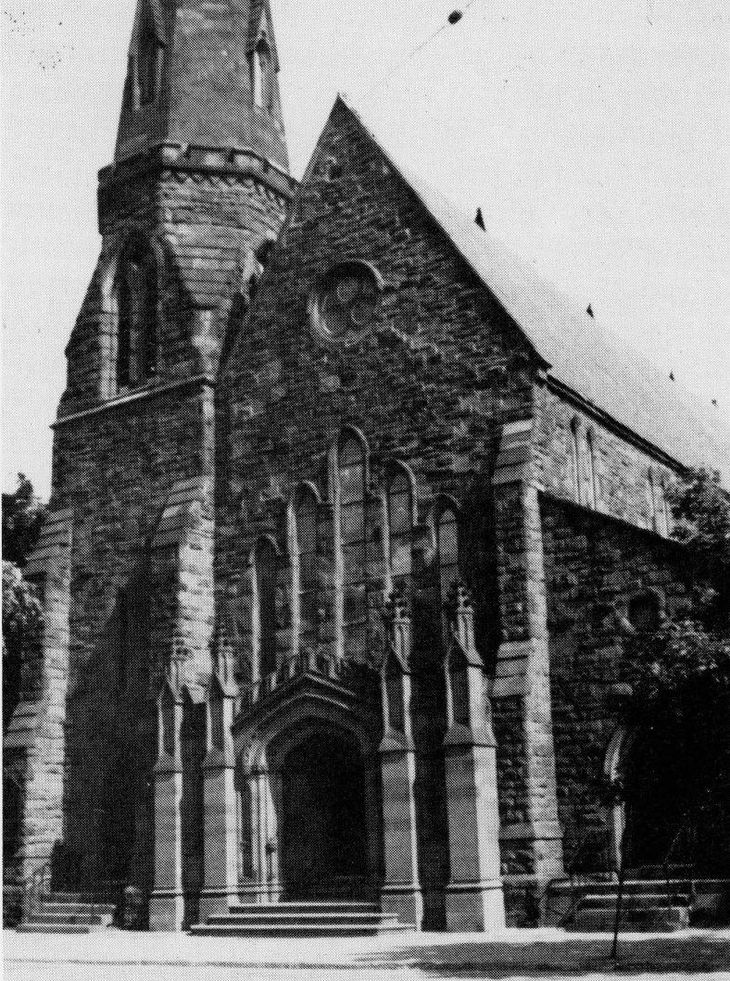
West front of the church in October 1980. The Knight
porch, Tillinghast doors, and Hare railings can been seen.
As part of its ministry to the poor the parish, hired Miss Florence B. Nye as Parochial Nurse in 1907. She was followed in 1908 by Miss Jessie A. Waddell. The program proved so successful that in June 1910 George B. Cluett endowed it with $25,000.
The quality of the music program seems to have declined badly during the early years of the century. In the spring of 1911 the rector complained that the music performed was not satisfactory and that the choir was “becoming disorganized.” The record does not indicate what, if anything, was done to improve the situation. We do know that problems had also developed with the chimes because they were recast in 1910-11.
In October 1912 the rector proposed enlarging the vestry from eight to twelve members and shifting the date of elections to the Monday in the week beginning with the first Sunday in Advent. The congregation ratified the changes on March 24, 1913. Despite the authorization to increase the number of vestrymen only one was added before 1948 for reasons that are unexplained.
The terrible flood of March 1913 was the highest recorded up to that time. It damaged the basement of the church, playing havoc with the organ, and surged through both the rectory and the parish house. The church could not be used again until mid-April. After the water receded the Cluett's again came to the rescue of the organ. Mrs. George B. Cluett and her children contributed the $5,600 needed to put the instrument back in working condition.
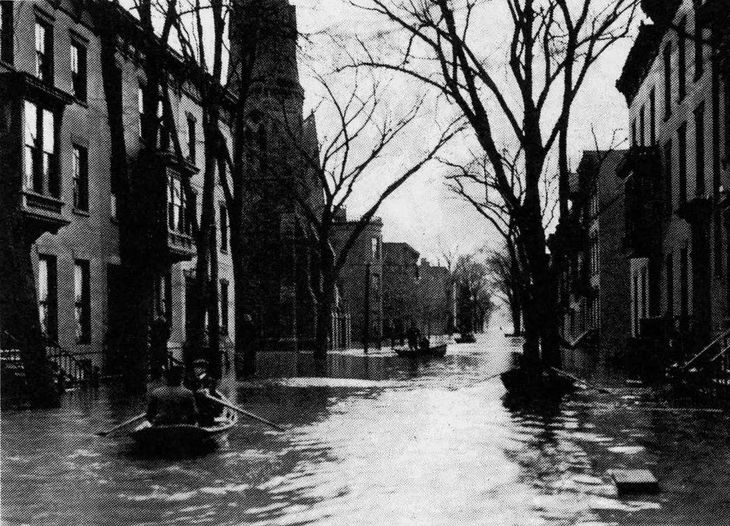
St. John's during the 1913 flood, the highest to devastate Troy.
Two years later Mrs. Cluett offered a new pulpit as a memorial to her husband. Installation of the pulpit late in 1916 required removal of the brass one given in 1878 by W. Stone Smith in memory of his first wife. The second Mrs. Smith, when consulted, evinced no interest in the pulpit and no objection to its removal to the parish house.
Although St. John’s continued to rely on pew rents and specified collections to finance its activities many other churches had converted to duplex envelopes by 1915. That year the conservative St. John’s vestry joined the converts. Two years later they joined the Church Pension Fund.
Although the Troy Citizen Corps, the Troy militia unit in which Freeman was active, served along the Mexican border in 1916 it was not until American entry into World War I the following year that large numbers of men from St. John’s entered service. By the time of armistice in 1918, 34 men of the parish had gone to war. All but one returned.
As the 1920s progressed St. John’s continued as before with little change in its activities although the parish lost much of its vitality. Why? In part because the general decline of Troy and its leadership was now well advanced; the younger generation which had been understandably shaken by the events of World War I demonstrated less interest in formal religion; and Mr. Freeman was himself aging and unwilling to modify his ministry to meet the changing conditions of his parish. As Senior Warden W. Leland Thompson lamented, “for many years we have been going along endeavoring to keep up with less interest and no increase in Troy’s population and hence little in the church.” Nevertheless, two events should be noted. The first was the dedication in September 1927 of the stone “Hymnal Boards" flanking the chancel stairs and pulpit. They were a memorial of Charles A. Stone to his mother and were executed by Tiffany and Company. The second was the initial use of the Revised (1928) Prayer Book on December 1, 1929. The transition from the traditional prayer forms to the newer forms was relatively uneventful when compared to the reaction on the part of some of the Episcopal community to the recent shift of prayer books.
Freeman reached retirement age on March 10, 1930. The vestry voted him a purse of $5,000 and in anticipation of his successor “determined at least to make the church property presentable and self-respecting by having needed repairs and decorations done.” They decided to tear down the rectory because of the high cost of its necessary repairs but later changed their minds when they found the building could be rented.
In September Nelson M. Burroughs was called. Since 1930 was also the church’s centennial year, the celebration and Mr. Burroughs’ installation were both set for November 30. Since the nation was deeply mired in the depression only a few centennial gifts were received. Miss Mary J. Ellard presented a brass alms basin stand as well as an alms basin and a processional cross. The Memorial Fund added a pair of alms basins and two altar vases. Bishop G. Ashton Oldham officiated at the installation during which Freeman outlined the history of the church. The choir was augmented for the occasion by the Ladies Auxiliary Choir and a pair of imported soloists. Among the music performed was an offertory anthem “O Give Thanks” composed for the occasion by organist Richard Tweedy. About 300 persons attended the reception for Mr. Burroughs held on December 1 in the parish house.
One of Burroughs' earliest actions was to hire Louise G. Morton as social worker, visitor, church school superintendent, and secretary. Miss Morton certainly deserved her title of Assistant to the Rector. As a means of helping some of the unemployed young men in Troy, Burroughs with strong backing from his vestry, enlisted them in refurbishing the old upstairs chapel in the parish house. Out of their activities and a Sunday afternoon “high tea” grew an organization which took the name of the Enembe (NMB from Nelson M. Burroughs) Society. It attracted 30-35 men who helped each other and similar out of work men survive the pressures of their unemployment and to retain an active relationship with the church.
The refurbishing of the old chapel included the removal of the old altar, lecturn, credence table, chancel rail, and the Smith pulpit. The rail was repainted and moved to the baptistry, where it still is, while the pulpit was loaned to St. Luke’s. Unfortunately, it was not reclaimed when St. Luke’s closed. The lecturn and chancel chair were given to St. James Chapel in Delhi and the altar to Trinity Church, Granville.
Burroughs was active in working with the students at RPI, Russell Sage College, and Emma Willard School. He brought a large number of them to the church. One of the diocesan programs which Burroughs’ leadership brought into being were the Silver Bay Conferences for young people. It is still fondly remembered by many of the participants. Perhaps most successful of all Burroughs' efforts to attract the youth to St John’s was his resuscitation of the Church School. He restructured it along lines which served as the model for the diocese and witnessed a phenomenal growth to 240 pupils during his rectorate. One of the best remembered episodes of those years was the sight of the rector climbing the flag pole when enrollment reached 200.
By the spring of 1932 the full effects of the depression were being felt in the parish’s finances. Senior Warden Thompson reported in April that the parish would be unable to pay more than $2,400 of its quota for missions and could contribute nothing to the diocesan emergency fund. The decline in revenues coincided with a 25% drop in communicants between 1930 and 1934 as people “left the city in droves,” to quote Burroughs. Even so, by careful hoarding of its resources not until 1936 was the vestry forced to borrow money to meet operating costs.
In an effort to bring in new, younger blood onto the vestry Warren S. Blauvelt suggested that one or two younger men be nominated for the body. That proposal, like similar ones before and since, found little support beyond the acceptance of the rector’s proposal for a Junior Vestry. It apparently never functioned and only two of the men considered ever joined the vestry. Despite the times, Burroughs could speak in 1934 of the spirit and enthusiasm of the congregation and of his success in attracting young members. Yet at the same time, in a lament which most of his successors would echo, Burroughs complained of the lack of participation in the committees needed to operate the parish.
Under Burroughs the schedule of services changed. He dropped the Evening Prayer which Freeman had insisted on holding despite its lack of attendance and shifted other Sunday services. He celebrated Communion at 8:00 each Sunday morning and held Morning Service at 11:00. Church School for grades 4 through 12 came at 9:45 while that for the younger children was at 11:00.
Miss Nellie Cluett, the church’s most lavish supporter during the late 1930s, gave money in 1935 to refurbish the vestry room or sacristy. It has changed little since. The following year she financed repairs to the organ.
The long discussed demolition of the old rectory finally came in 1936. A group of ladies of the parish designed a memorial garden to fill the space between the church and the south boundary. They conceived of it as a “Garden of Memory to enshrine in living and jubilant symbols [St. John’s] love for the hundreds of citizens and churchmen who have walked these paths before them.” It would be open to all Trojans. The sunken garden on the site of the old rectory was dedicated as a special memorial to Freeman.
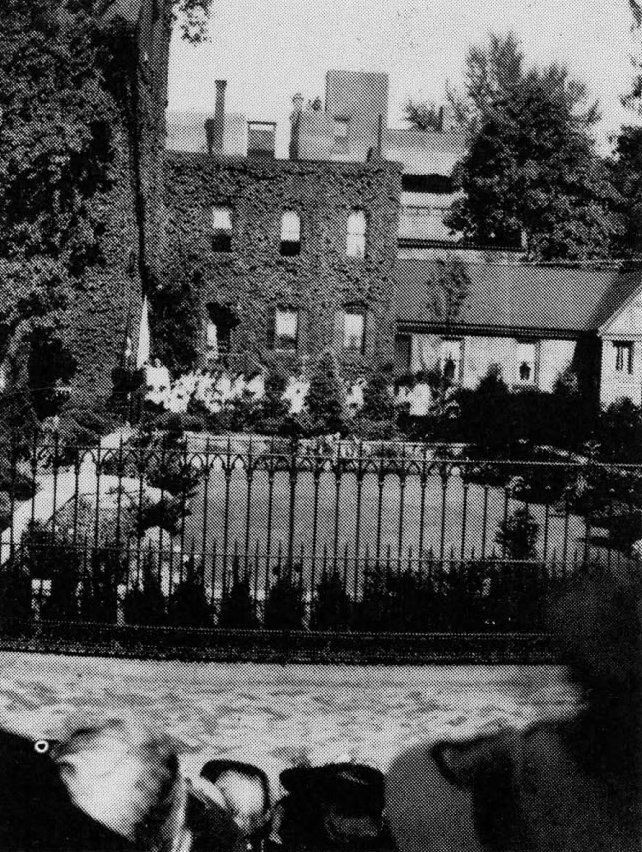
Dedication ceremonies for the Memorial Garden.
Money to pay for the garden was raised from a special subscription among individuals and organizations. The Enembe Society, for instance, put on a Minstrel Show as part of its effort to raise $200. The Police Benevolent Association contributed the wrought iron fence. The garden was dedicated during the afternoon of May 22, 1938 in a ceremony which included representatives of the local educational institutions, the Troy Citizens Corps, police, local and diocesan dignitaries as well as the Bishop of Washington, James Edward Freeman, brother of the late rector. Organist Tweedy composed a dedicatory hymn for the ceremony. The Daughters of St. John added a statue of St. Francis of Assisi which was dedicated on August 2, 1942.
During October 1938 the river once again flooded but the staff had sufficient warning to remove the material stored in the basement. Even so, the repairs to the foundation cost $3,032.
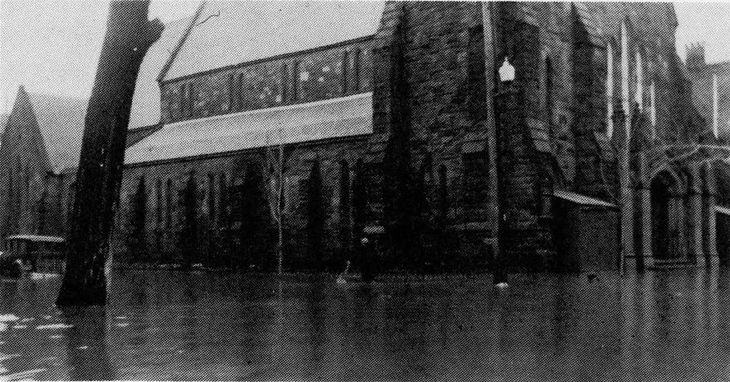
The flood of 1936. While not as high as that in 1913 it caused
extensive damage to the foundation of the building.
The parish recovered slowly from the depression. The 1939 budget included reductions in salary for the rector, organist, secretary, and sexton although most were restored during the year. Despite the financial problems the vestry authorized Burroughs to hire a curate, Rev. Robert M. Morris, in June. He was the first assistant to serve the parish since Thomas Cole in 1913. In September Burroughs resigned to accept a call to Christ Church, Cincinnati, Ohio, taking Morris with him. In 1956 Burroughs became Bishop of Ohio.
Nelson Burroughs’ rectorate was an important one in the modern history of the parish. He roused St. John’s from its stultifying lethargy of post-World War I period, brought younger men into active roles in the church, and laid the foundation for the great growth which the parish would experience after World War II. The figures on church attendance are enlightening. From a normal Sunday congregation of less than 100 when he arrived, Burroughs could look forward to nearly 200 when he departed for Ohio. It is scarcely surprising that he is remembered with a special fondness by those who came of age in the church during his years.
The vestry formally called Rev. Gray M. Blandy from Cambridge, Massachusetts in December 1939. He began his service in February 1940. Almost immediately the congregation found themselves in various wartime activities. The women’s groups hastened to contribute knitting and sewing to support the Red Cross, Bundles for Britain, the USO, and local hospitals. In 1944, for instance, they made 2,340 articles and 2,364 surgical dressings. No count appears to have been made of the number of members of the parish who served in the armed forces during World War II but they undoubtedly outnumbered those who participated in World War I.
During the spring of 1941 it became clear that the rented rectory at 1697 Tibbits Avenue was inadequate for the Blandys so the vestry decided to rent a new house. In 1944 the rectory moved to 157 Pawling Avenue and later to 23 Myrtle Avenue.
When gasoline rationing prevented distant parishioners from reaching church several efforts were made to develop satellite centers. As early as September 1942 Blandy discussed with Christ Church the possibility of a joint Sunday School in a vacant store in the Wynantskill Flats. The idea came to naught when no usable location could be rented. No more successful was Blandy’s offer of the parish house for a day nursery. But neither did the shortage of heating oil reach such proportions as to force combined services with St. Paul’s as some feared. When it became clear that a substantial group of Episcopalians in Latham could not travel to church, Bishop Oldham authorized St. John’s to organize a chapel in the area. Services started during November 1943 in a room at the S. W. Pitts Hose Company on Old Loudon Road. The congregation continued to be active after the war and in 1951 moved into larger quarters at the Colonie Grange.
Blandy resigned in February 1944 to accept charge of a missionary district in Houston, Texas. He later became Dean of the faculty of the Seminary of the Southwest. As his successor Bradford H. Burnham was called from St. John’s Church, Beverly Farms, Massachusetts in June. In preparation for the Burnhams’ arrival the vestry purchased a house at 30 Hawthorne Avenue for use as a rectory. Burnham was installed on September 24 with Bishop Oldham officiating.
On October 16, 1945 Chester F. Millhouse replaced former Congressman E. Harold Cluett as warden. Once again a shift in wardens signified a change in the leadership of the city. The detached collar and cuff which had been the economic mainstay of Troy succumbed to the attached collar shirt, notably the Arrow of Cluett, Peabody and Company, after World War I. While some factories were able to convert to shirt manufacturing they could not compete with those in the south. By the end of World War II little manufacturing, textile or otherwise, was left in Troy. As with most dying mill towns leadership passed to bankers, like Chet Millhouse, managers, and small businessmen.
Soon after his arrival Burnham introduced a Christmas Pageant which marked the start of a tradition which lasted through the Burnham years and beyond.
The question of changes in the choir, especially the addition of women, attracted much attention during the fall of 1946. Opposition from organist Tweedy killed the idea but five years later the glacier began to move. In 1951 seven girls sang with the choir. The response of the congregation was positive so the Music Committee recommended that they receive the same token wages as the boys. The committee also recommended acceptance of women volunteers and suggested that the choir contain at least 12 boys and 12 girls plus adults. The new arrangement took effect in January 1952. The following autumn H. Wellington Stewart, the son of a former organist, joined the Music Department at Russell Sage College and relieved Tweedy as organist and choirmaster.
On December 17, 1946 the vestry authorized the employment of a curate to shoulder some of the additional responsibilities generated by the Latham chapel. The right man was difficult to locate and the first, Rev. John Davidson, did not appear until the summer of 1948. A series of other young clergymen* served between 1948 and 1977 splitting their time between St. John’s and its satellites. In addition, the recently retired Rev. Jerrold C. Potts from Hoosick Falls served as vicar intermittently between 1952 and 1967.
______________
*See list in appendix
When St. Luke’s Church lost its minister in 1952 and could not afford a successor, Bishop Frederick L. Barry requested St. John’s assume a responsibility for the parish. Burnham and his vestry quickly agreed. Soon afterwards they accepted a similar role with St. Mark’s Church, Green Island. Although St. Mark’s had not been one of the mission churches in whose founding St. John’s had participated, its chief promoter and supporter was Uri Gilbert, a long time member and vestryman of St. John’s.
The question of vestry rotation arose again during the spring of 1947 but no resolution appeared until the November 1948 decision to enlarge the body to 12, the number provided in the 1913 amendment to the church charter. Even then the vestry moved slowly. It filled one of the new billets in January 1949 and the second the following March. The third new seat went to Chester Richards in November 1950 to give representation to the Latham group.
In February 1948 Burnham, for the Troy Area Council of Churches, brought Canon Michael E. Coleman from British Columbia to conduct a lenten mission. It culminated in a union service at the Troy Music Hall. Newspaper accounts note that the fire authorities closed the hall after 2,500 had entered and had to turn away another 500. Coleman returned in 1963 for a second mission which included an equally successful mass service at the RPI Field House.
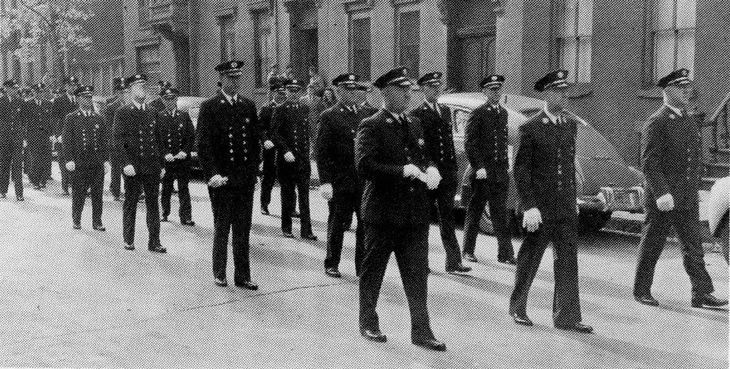
Troy Firemen march to their annual service at St. John's about 1950. For over half a
century the church's rectors served as Protestant chaplains to the Fire Department.
In June 1951 the vestry considered acquiring a new rectory but nothing was done before the mortgage on the Hawthorne Street house was paid off on July 1, 1953 through the generosity of Warden Thompson. Before any further action was taken Miss Josephine Hare left the church her home at 17 Locust Avenue. After extensive discussion it was decided to refit the house as a rectory. The necessary renovations were largely paid for from the proceeds of the sale of the Hawthorne Street property.
During the spring of 1953 it became clear that the organ needed major repairs but the estimated cost of $37-38,000 staggered the vestry. Miss Nellie Cluett came to the rescue by commissioning the Aeolian-Skinner Organ Company to build a new instrument. It was a memorial to her four brothers along with a modified organ screen designed by Graham Williams and decorated with medallions designed by Mrs. Burnham and carved by the late Rev. Theodore Haydn. The organ was dedicated on Armistice Day 1956; that evening Wellington Stewart gave the initial recital on it.
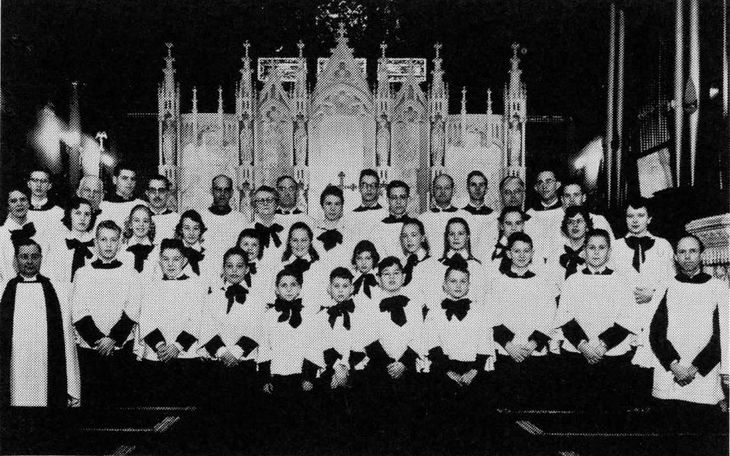
The choir stands for its portrait in about 1955.
The dispersal of the congregation from Troy to the suburbs during the 1950s severely cut into the attendance at Church School. Various ways of countering the loss were discussed and in 1953 an experimental bus system was instituted. It proved sufficiently attractive to be retained until 1959 when a new Church School schedule allowed the children to come with their parents.
Meanwhile, the Latham Chapel continued its growth and by November could report that its members had oversubscribed their building fund. The building, estimated to cost $40,000, was designed by Harrison & Mero. Its cornerstone was laid by Bishop Barry on September 12, 1954 and the building consecrated as St. Matthew’s Church. A Church School wing was added in 1957 and four years later the parish was strong enough to set forth on its own with Rev. Stephen W. Gillespie, the former vicar, as rector.
In April 1954 Elmer and Henry Hempstead presented new alms basins as a memorial to their mother; eight years later Henry’s son Henry had a window installed in honor of his parents. Miss Hare had left money in her will for the installation of iron railings for the front entrances. They were installed at the north and south entries in 1955. Much different in texture were the magnificent set of needlepoint altar cushions designed by Mrs. E. Harold Cluett and made by a group of ladies of the parish in 1962. Each cushion contains a different, but related, design.
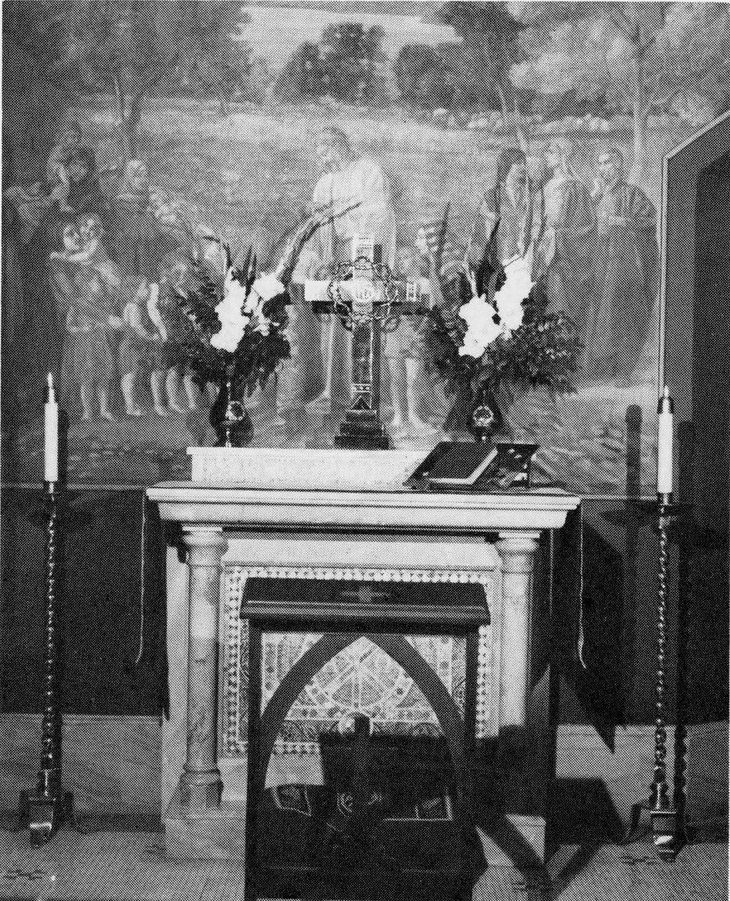
The chapel alter as it appeared about 1965.
By 1957 it was clear that if the parish were to attract more members it needed to enlarge the parish house or provide adequate parking or both. In 1957 average attendance at a Sunday service was 219, down from 255 in 1952 and no higher than it had been a decade earlier. Faced with the deteriorating situation, the vestry at the urging of the rector took an uncharacteristically bold step. They decided to initiate a program to raise the money to redecorate the church, build a new parish house, and provide adequate parking. That fall a capitol fund drive for $200,000 headed by Warden Chester Millhouse got underway with the advice of professional fund raisers. At the end of its three-year life the drive had produced $194,367.
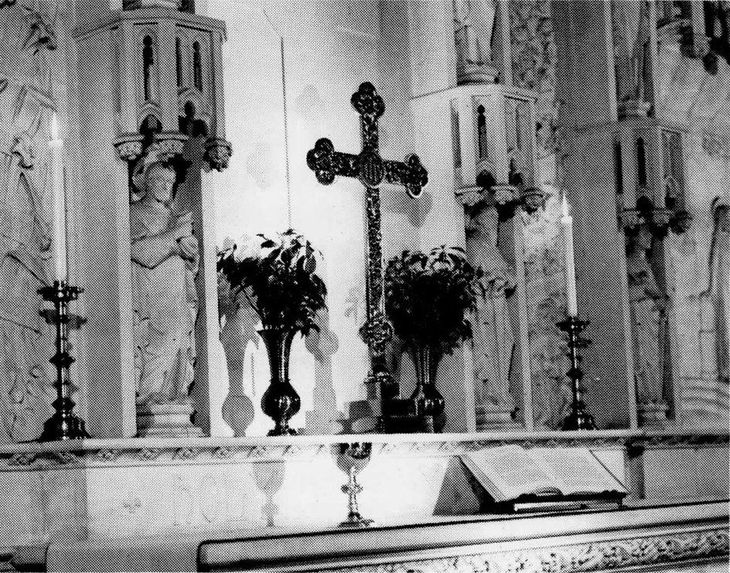
The beauty of the altar and reredos show clearly in this photograph taken about 1965.
One of the inhibiting factors which prevented construction of a wholly new parish house had been the lack of space to house the Church School and other activities during construction. This was solved when it became possible to purchase the property at 154 First Street. As a result the cornerstone of the new parish house was laid by Bishop Barry on September 28, 1958. The sandstone building with its limestone trim was another product of Harrison & Mero. It contained 14 classrooms, a music room, a meeting room, lockers and showers, offices, a gymnasium, and a kitchen.
All of the church organizations played a role in raising money. Notable among the fund raising projects, aside from the jello parties, was the Couples’ Club Carnival held on a lot at Pawling and Spring Avenues on June 13, 1959. The parish house dedication on September 27, 1958 by the Bishop included a visit to each of the rooms.
While impetus for the new parish house had come from the Superintendent of the Church School, William C. Gibson, and a number of interested parents, its completion allowed Burnham to achieve a dream. It permitted him to establish a parochial day school in 1959. The school offered education in small classes from pre-school years through the sixth grade. It also had a special class for retarded children under the age of six. The latter was the only one available in the state of New York. Miss Adelaide Hill was the first principal. She was followed by Mrs. Paul R. Gifford in 1961 and Mrs. Ann Snyder in 1972. At its peak the school enrolled 170 students and had an outstanding group of 18 teachers. By 1973 enrollments had dropped to 65 and strong competition arisen elsewhere in Troy. Faced with a large deficit if it continued operating the Day School closed.
The second objective of the modernization program, a parking lot, was accomplished in 1960. The church purchased and demolished a pair of houses on First Street and one on Liberty. These with additional property on First Street acquired in 1963 gave adequate off-street parking.
We have already noted the willingness of Burnham and his vestry to lend support to ailing parishes. They were no less ready to start new ones. In 1958 St. John’s established a mission in West Sand Lake. It struggled for several years but never developed a congregation large enough to warrant continuation. It closed in 1965. Meanwhile, in October 1962, Burnham brought Holy Cross into the St. John’s constellation. Its rector, Rev. J. Anthony G. Morris, became vicar there and associate rector at St. John’s. Burnham served both as the nominal rector of Holy Cross and Director of its attached Mary Warren School. The arrangement was complicated by the existence of the school which had long since outlived its usefulness but legally could not be closed.
Burnham was an active churchman who, as we have seen, played a major role in the Troy Area Council of Churches. Not only did he arrange for the two Coleman missions but in 1961 he was appointed by Bishop Allen W. Brown as half of a two-man committee to organize an assembly of business leaders from the northeast. It culminated in a long remembered and very successful gathering in the RPI Field House at which the historian Arnold Toynbee and the diplomat Henry Cabot Lodge appeared. The previous year, 1960, Burnham served as General Chairman of the Diocesan Development Fund which raised about $1 million. He served as the administrator of the $400,000 diocesan fund for the support of needy parishes and in 1966 took charge of the Diocesan Second Century Program which produced another $1.2 million.
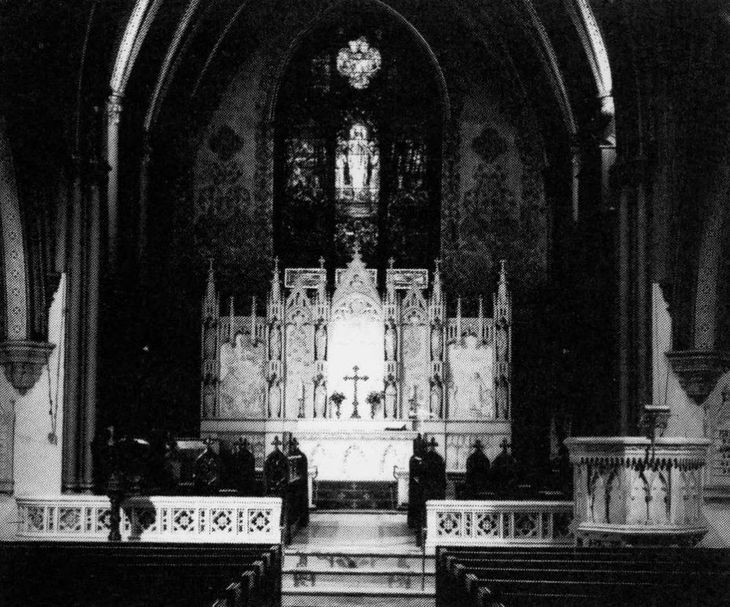
The chancel as it appeared before the 1968 redecoration.
The success of the parish's 1958-61 fund drive encouraged yet another canvass to pay for the redecoration of the interior of the church. The redecoration took place during the summer of 1968 according to designs prepared by Rambusch Decorating Company. The unused organ pipes at the end of the south aisle were replaced by a screen containing a statue of St. John presented by Mr. and Mrs. Ellis Robison in memory of their parents and a display table for the book of remembrance installed. The nave and chancel were repainted and new lighting emplaced. Mr. and Mrs. Chester Millhouse added a window the following year as a memorial to their parents. He subsequently gave a set of vestments, an altar fall, and bible markers in her memory. In 1976 Mrs. John A. Becker and other members of the Thompson family presented the church with a pair of exterior tinted glass center doors. They were designed by Graham Williams. At the same time Mrs. Sara Smith presented the clear interior doors which allow a view of the chancel from the street.
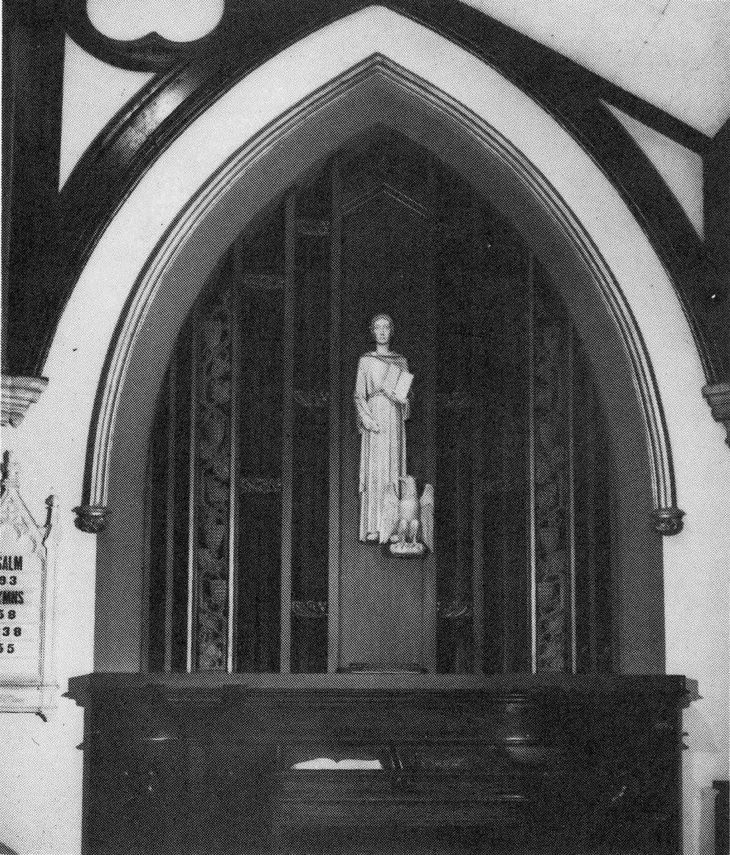
The statue of St. John installed during the 1968 redecoration.
Burnham announced his impending retirement in 1969. The diocese honored him with appointment as an Honorary Canon of the Cathedral of All Saints while the parish held a retirement dinner on September 17. In preparation for his departure the satellite churches were cut loose; St. Mark’s and Holy Cross on September 1, 1969 and St. Luke’s the following May.
The new rector, Frederick C. McQuade, was called from St. Eustace in Lake Placid. His rectorship was largely absorbed in efforts to solve the financial difficulties faced by the shrinking, absentee populated urban church. In an effort to broaden parish leadership and assist the vestry in some of its duties a 12-member Associate Vestry (later renamed Parish Council) was formed in 1972. It never found a satisfactory purpose and was disbanded in 1980. Although women had been included in the Associate Vestry from its formation and had voted in parish elections since the mid-18th century their election to the vestry was not authorized by the congregation until November 1974. The opening of the vestry to women has been neither the disaster that its opponents anticipated nor the cure-all that its extreme supporters foresaw. Mr. McQuade resigned July 1, 1977.
After a long search J. Seymour Flinn was called from Greenwich, Connecticut. He was formally installed June 17, 1978. A former missionary, Mr. Flinn has sought to return St. John’s to its tradition of active concern for the community around it. He has also led efforts to broaden the leadership group within the parish.
Today St. John's retains many of the earmarks of its history. It continues, as it apparently has always been, a low church in a high church diocese and as a major contributor to the coffers of the broader church. It has had its share of dynamic leaders and a handful of its parishioners of natural stature. Three, including Rev. Henry Codman Potter, have received the ultimate distinction of inclusion in the Dictionary of American Biography. Despite its emergence in 1890-1910 as a moderately wealthy and socially desirable church, St. John’s history is little different from that of many other urban parishes. What its history will be in the next century and a half is hard to foresee although we can begin to sense a brighter future as urban centers, even in the old industrial belt, begin to revive. But above all else we can be sure St. John’s will face that unknown future with the same resolve, innovativeness, and Christianity which have marked its life to the present.
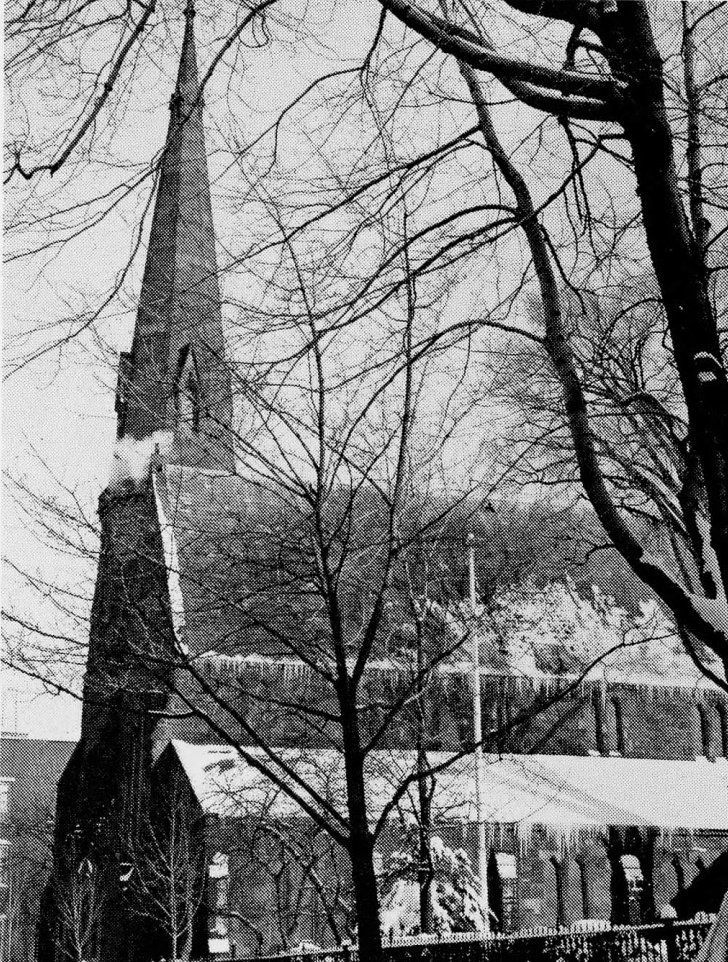
The frigid exterior of St. John's belies the warmth of its interior.
APPENDICIES
RECTORS
| John A. Hicks ..................................1831-1832 | Henry C. Potter ....................................1859-1866 |
| Herman Hooker ..............................1832-1833 | George H. Walsh ..................................1866-1876 |
| Henry R. Judah ...............................1833-1835 | Frank L. Norton ...................................1876-1880 |
| Gordon Winslow .............................1836-1837 | Thaddeus A. Snively ............................1881-1892 |
| Richard Cox ....................................1837-1844 | Henry R. Freeman ...............................1892-1930 |
| William H. Walter ..........................1844-1846 | Nelson M. Burroughs ..........................1930-1939 |
| Abraham Beach Carter ...................1846-1847 | Gray M. Blandy ...................................1939-1944 |
| Edward Lounsberry ........................1847-1854 | Bradford H. Burnham ........................1944-1969 |
| Richard Temple ..............................1854-1856 | Frederick C. McQuade ........................1969-1977 |
| J. Brinton Smith .............................1856-1859 | J. Seymour Flinn .................................1978- |
JUNIOR CLERGY
| James Caird..........................................1870-1873 | Stephen W. Gillespie .....................................1953-1960 |
| George F. Breed ...................................1878-1879 | Frederic C. Guile............................................1954-1956 |
| William M. Barker ...............................1879-1880 | Thomas F. Brereton ......................................1958-1960 |
| Hobart Cooke...........................................1882-1883 | Frederick J. Eastman.....................................1960-1962 |
| John B. Harding.......................................1883-1884 | Irving F. Ballert, Jr........................................1962-1965 |
| Henry Macbeth ........................................1884-1885 | J. Anthony G. Morris ....................................1962-1969 |
| E. D. G. Tompkins.....................................1885-1888 | James E. Imler, Jr. ........................................1965-1967 |
| Thomas L. Cole .........................................1913 | Roger L. Prokop ............................................1967-1968 |
| Robert M. Morris ......................................1939 | Richard F. Simmonds ...................................1967-1970 |
| John F. Davidson ......................................1948-1949 | Charles G. Ackerson .....................................1970-1972 |
| James Frew Martin ...................................1949-1950 | Joel A. MacCollam ........................................1972-1975 |
| Albert W. Anderson ...................................1950-1952 | Jonathan MacKenzie ....................................1975-1976 |
| Kendall H. Edkins.......................................1952-1954 | Ronald D. Gerber .........................................1976-1977 |
| Jerrald C. Potts ....1952-1953, 1956-1958, 1960-1967 |
WARDENS*
| David Buel, Sr. .........................................1830-1836 | William M. Sanford ...........................................1910-1918 |
| John Whiton ............................................1830- ? | William Leland Thompson ...............................1918-1957 |
| Elisha Orvis ..............................................? -1844 | E. Harold Cluett ................................................1923-1945 |
| Francis N. Mann ......................................1840-1880 | Chester F. Millhouse ........................................1945-1976 |
| John N. Downing .....................................? -1867 | Paul R. Jones ....................................................1957-1961 |
| Norman B. Squires ..................................1867-1907 | William R. Harrison .........................................1961-1980 |
| Charles W. Tillinghast .............................1880-1910 | Douglass L. Bartow ..........................................1976- |
| James M. Ide ...........................................1907-1923 | Booth Carey ......................................................1980- |
*The list is incomplete because of gaps in the records.
VESTRYMEN*
| David Buel, Jr. .........................................1830-1860 | George L. Hare ...................................................1918-1930 |
| Henry Rousseau .......................................1830- ? | James Morehead ................................................1918-1943 |
| Lewis Rousseau ........................................1830- ? | Charles A. Stone .................................................1918-1940 |
| Asahel Gilbert, Jr. ....................................1830- ? | C. Harold Nash ...................................................1923-1944 |
| Darius Weed ............................................1830-1834? | George P. Ide II ..................................................1928-1933 |
| Francis N. Mann ......................................1830-1840 | Clarence H. Wall ................................................1925-1928 |
| Dr. Charles S. J. Goodrich .......................1830- ? | George W. Holberg ............................................1930-1934 |
| Dr. Melzar Flagg ......................................1830- ? | Dr. Harry W. Carey ...........................................1930-1935 |
| John H. Willard .......................................1840-1856? | Dr. Peter L. Harvie ............................................1930-1944 |
| Lyman Garfield ........................................1841-1863 | Warren S. Blauvelt ............................................1931-1937 |
| Dennis N. Fitch ........................................1849?-1852? | Charles H. Brennen ...........................................1934 |
| John N. Downing .....................................1861?-1862? | James T. Young .................................................1934-1946 |
| Alfonso Bills .............................................? -1869 | William E. Bode ................................................1934-1973 |
| Norman B. Squires ..................................1849?-1867 | Edward B. Sullivan ...........................................1934-1937 |
| Henry Robbins ........................................? -1867 | Chester F. Millhouse ........................................1936-1945 |
| James S. Keeler ...................? -1866, 1867-1869 | Arnold R. Derrick .............................................1937-1939 |
| Walter Gillespie ......................................? -1863 | Judge Herbert D. Hamm..................................1937-1957 |
| Joseph B. Wilkinson ..............................? -1878 | Edward Freeman .............................................1940-1974 |
| Silas L. Covell.........................................? -1864 | Malcolm S. Kelley ............................................1941-1945? |
| Jonas S. Heartt ......................................1863-1866 | Dudley P. Van Arnum .....................................1944-1948 |
| William A. Shepard......................1866, 1869-1880 | John Roblin .....................................................1944-1948 |
| Benjamin H. Hall ..................................1864-1879 | Elmer A. Hempstead .......................................1945-1961 |
| George Babcock .....................................1866-1874 | Philip S. Dorlon ...............................................1945-1949 |
| Thomas A. Tillinghast ...........................1866-1879 | John McCreary ................................................1946-1969 |
| Thomas W. Tibbits ................................1866-1870 | Clinton E. Rose ................................................1946-1953 |
| William A. Thompson ...........................1867-1903 | William C. Gibson ............................................1948-1976 |
| C. E. Dudley Tibbits ..............................1869-1881 | William R. Harrison ........................................1949-1961 |
| Charles A. McLeod ................................1870-1898 | Douglass L. Bartow..........................................1949-1976 |
| George T. Lane ...................1874-1879, 1881-1882 | William A. Simmons .......................................1949-1951 |
| William E. Gilbert .................................1878-1881 | Chester Richards .............................................1950-1975 |
| Francis N. Mann, Jr. .............................1879-1912 | W. Donald Coleman ........................................1951-1963 |
| James W. Cusack ..................................1879 | Paul R. Jones ...................................................1951-1957 |
| Charles W. Tillinghast ..........................1879-1880 | Edward A. Lory ...............................................1953-1975 |
| William M. Sanford ..............................1879-1910 | John Sarkis .....................................................1960- |
| W. Stone Smith .....................................1880-1890 | George H. B. Frayne .......................................1960-1976 |
| George A. Wells .....................................1880-1907 | Richard E. Bolton ...........................................1961-1971 |
| Edward G. Gilbert ........................1881, 1888-1893 | C. Wellington Gray .........................................1961- |
| Dr. Samuel D. French ............................1881-1889 | Richard W. Keeler ..........................................1963-1973 |
| Uri Gilbert ..............................................1882-1888 | Philip C. Lessels .............................................1969-1975 |
| Charles A. Brown ...................................1889-1890 | Booth Carey ...................................................1971-1980 |
| James M. Ide .........................................1890-1923 | Graham G. Williams ......................................1973- |
| Dr. William P. Mason ............................1890-1930 | Dr. David R. Tomlinson .................................1974-1980 |
| Charles E. Hanaman ..............................1892-1916 | Warren Kelly ..................................................1974-1978 |
| William Lord Hall ..................................1899-1918 | John B. Groom ...............................................1975- |
| William Leland Thompson ....................1903-1918 | Martha T. Becker ...........................................1975- |
| George B. Cluett .....................................1902-1912 | Helen Jones....................................................1975- |
| C. Whitney Tillinghast II........................1907-1912 | K. Jack Bauer..............................1976-1977, 1980- |
| Robert Cluett, Jr. ...................................1910-1913 | James H. Bowman.........................................1976- |
| E. Harold Cluett .....................................1912-1923 | Robert Swanick .............................................1976-1977 |
| Elias P. Mann .........................................1913-1918 | Warren E. Huntley ........................................1977-1980 |
| Herbert S. Ide ........................................1913-1925 | J. Robert Montgomery ..................................1977- |
| James F. Upham ....................................1913-1930 | Ira Harrod .....................................................1978-1979 |
| Frank E. Norton .....................................1914-1931 | Curtis Stancliffe ............................................1979- |
| George B. Pattison .................................1916-1934 | Gerald Tysiak.................................................1980- |
| William M. Dauchy .......................................1980- |
*The list is incomplete because of gaps in the records.
ORGANISTS and CHOIR DIRECTORS*
| Jane P. Lincoln .....................................1846?-1848 | John B. Riley .............................................. 1903 |
| James W. Andrews ...............................1848-1850 | Moritz Hauptmann Emery .......................1904-1906 |
| T. J. Wallace .........................................1855-1857 | Edward F. Johnson ...................................1906-1907 |
| C. F. Conkey ..........................................1857-1861? | Louis A. Coerne .........................................1907-1909 |
| O. R. Greene .......................................... -1874? | Robert S. Loudon ......................................1909-1910 |
| James E. VanOlinda.............................1874?-1879 | Theodore G. Beach ....................................1910-1911 |
| Henry S. Church ..................................1880-1884 | Alfred R. Willard .......................................1911-1913 |
| W. W. Rousseau ...................................1884 | Arthur Edward Jones ................................1913-1915 |
| Charles A. White ..................................1886?-1887 | Richard P. Law ..........................................1915-1925 |
| Philip Hale...........................................1887-1889 | Henry W. Stewart ...................................... 1925 |
| ......... Lindsay .....................................1889-1890? | Richard Tweedy ........................................1925-1952 |
| William H. Purdy .................................1893?-1899 | H. Wellington Stewart...............................1952-1979 |
| Beecher Aldrich ...................................1899-1900 | Jay Adams.................................................1979-1980 |
| Waldo Paul Vinal .................................1900-1902 | Peter Mahigian .........................................1980- |
| George B. Loveday.................................1902-1903 |
*The list is incomplete because of gaps in the records.
STATISTICS
|
Y |
B |
C |
M |
B |
C |
| 1831 | 8 | 12 | 1 | 3 | 17 |
| 1832 | 10 | 0 | 0 | 0 | 48 |
| 1833 | 11 | 10 | 2 | 0 | |
| 1834 | 14 | 0 | 6 | 11 | 75 |
| 1835 | 22 | 16 | 4 | 15 | |
| 1836 | 14 | 14 | 4 | 5 | 82 |
| 1837 | 7 | 0 | 0 | 12 | 66 |
| 1838 | 19 | 22 | 6 | 16 | 92 |
| 1839 | 32 | 12 | 4 | 19 | 98 |
| 1840 | 40 | 18 | 9 | 15 | |
| 1841 | 35 | 15 | 7 | 15 | 119 |
| 1842 | 35 | 8 | 8 | 20 | 131 |
| 1843 | 22 | 31 | 7 | 21 | |
| 1844 | 14 | 5 | 1 | 7 | 150 |
| 1845 | 17 | 0 | 3 | 7 | |
| 1846 | 23 | 6 | 2 | 10 | |
| 1847 | 16 | 8 | 3 | 15 | |
| 1848 | 17 | 0 | 4 | 10 | |
| 1849 | 11 | 12 | 3 | 10 | |
| 1850 | 12 | 0 | 2 | 5 | |
| 1851 | 11 | 12 | 4 | 10 | |
| 1852 | 13 | 19 | 2 | 10 | |
| 1853 | 21 | 18 | 9 | 8 | 112 |
| 1854 | 10 | 14 | 5 | 7 | |
| 1855 | 16 | 20 | 6 | 8 | |
| 1856 | 7 | 0 | 0 | 6 | |
| 1857 | 31 | 48 | 6 | 6 | |
| 1858 | 15 | 14 | 4 | 8 | |
| 1859 | 11 | 0 | 5 | 8 | 150 |
| 1860 | 42 | 20 | 8 | 22 | |
| 1861 | 31 | 0 | 6 | 18 | |
| 1862 | 23 | 25 | 6 | 8 | |
| 1863 | 23 | 9 | 6 | 13 | |
| 1864 | 14 | 0 | 11 | 14 | |
| 1865 | 27 | 42 | 4 | 18 | |
| 1866 | 31 | 20 | 4 | 3 | 305 |
| 1867 | 25 | 26 | 13 | 7 | |
| 1868 | 22 | 7 | 10 | 6 | |
| 1869 | 18 | 12 | 12 | 13 | |
| 1870 | 16 | 14 | 6 | 7 | |
| 1871 | 20 | 11 | 3 | 16 | |
| 1872 | 32 | 29 | 6 | 15 | |
| 1873 | 25 | 23 | 4 | 14 | |
| 1874 | 12 | 22 | 6 | 6 | |
| 1875 | 20 | 10 | 5 | 17 | |
| 1876 | 7 | 24 | 2 | 10 | |
| 1877 | 56 | 39 | 5 | 11 | |
| 1878 | 39 | 49 | 7 | 11 | |
| 1879 | 54 | 35 | 4 | 17 | 500 |
| 1880 | 37 | 24 | 7 | 20 | |
| 1881 | 14 | 6 | 5 | 12 | 443 |
| 1882 | 27 | 12 | 5 | 14 | 447 |
| 1883 | 6 | 13 | 4 | 28 | |
| 1884 | 34 | 19 | 5 | 12 | |
| 1885 | 23 | 30 | 2 | 24 | |
| 1886 | 11 | 9 | 5 | 11 | 467 |
| 1887 | 19 | 12 | 8 | 15 | 456 |
| 1888 | 30 | 24 | 7 | 17 | |
| 1889 | 18 | 21 | 2 | 17 | |
| 1890 | 36 | 25 | 1 | 24 | |
| 1891 | 30 | 14 | 3 | 22 | |
| 1892 | 25 | 18 | 10 | 25 | |
| 1893 | 23 | 25 | 9 | 27 | |
| 1894 | 49 | 38 | 5 | 13 | 505 |
| 1895 | 37 | 45 | 9 | 14 | 550 |
| 1896 | 25 | 0 | 11 | 23 | 550 |
| 1897 | 38 | 36 | 6 | 25 | 586 |
| 1898 | 22 | 27 | 6 | 32 | 613 |
| 1899 | 18 | 27 | 5 | 22 | 640 |
| 1900 | 23 | 27 | 12 | 26 | 540 |
| 1901 | 17 | 21 | 9 | 33 | 551 |
| 1902 | 9 | 29 | 2 | 13 | 584 |
| 1903 | 16 | 12 | 7 | 14 | 596 |
| 1904 | 15 | 16 | 9 | 7 | 599 |
| 1905 | 13 | 12 | 2 | 27 | 589 |
| 1906 | 12 | 14 | 5 | 13 | 621 |
| 1907 | 21 | 17 | 9 | 15 | 629 |
| 1908 | 8 | 14 | 8 | 17 | 637 |
| 1909 | 14 | 12 | 10 | 22 | 645 |
| 1910 | 28 | 15 | 7 | 16 | 648 |
| 1911 | 18 | 19 | 7 | 21 | 661 |
| 1912 | 6 | 0 | 8 | 24 | 661 |
| 1913 | 7 | 23 | 1 | 16 | |
| 1914 | 8 | 14 | 4 | 18 | |
| 1915 | 16 | 22 | 5 | 19 | |
| 1916 | 16 | 19 | 5 | 15 | |
| 1917 | 9 | 12 | 4 | 17 | |
| 1918 | 17 | 9 | 5 | 27 | |
| 1919 | 21 | 12 | 7 | 19 | |
| 1920 | 6 | 18 | 8 | 13 | |
| 1921 | 10 | 12 | 6 | 17 | |
| 1922 | 13 | 8 | 6 | 19 | |
| 1923 | 7 | 16 | 4 | 20 | |
| 1924 | 13 | 15 | 4 | 19 | |
| 1925 | 13 | 16 | 3 | 20 | |
| 1926 | 5 | 11 | 2 | 24 | |
| 1927 | 15 | 17 | 5 | 16 | |
| 1928 | 11 | 7 | 1 | 19 | |
| 1929 | 6 | 10 | 4 | 22 | |
| 1930 | 9 | 10 | 1 | 12 | 543 |
| 1931 | 11 | 2 | 4 | 17 | |
| 1932 | 10 | 8 | 5 | 19 | |
| 1933 | 20 | 23 | 7 | 31 | |
| 1934 | 15 | 18 | 2 | 21 | 408 |
| 1935 | 5 | 25 | 3 | 38 | 450 |
| 1936 | 10 | 35 | 8 | 14 | 484 |
| 1937 | 8 | 26 | 10 | 29 | 512 |
| 1938 | 21 | 34 | 11 | 12 | |
| 1939 | 13 | 28 | 17 | 18 | |
| 1940 | 22 | 17 | 7 | 17 | |
| 1941 | 23 | 17 | 11 | 16 | |
| 1942 | 27 | 21 | 7 | 17 | |
| 1943 | 21 | 22 | 4 | 27 | |
| 1944 | 15 | 1 | 2 | 13 | |
| 1945 | 16 | 42 | 7 | 15 | |
| 1946 | 21 | 28 | 11 | 21 | |
| 1947 | 23 | 32 | 13 | 22 | |
| 1948 | 25 | 23 | 18 | 5 | 981 |
| 1949 | 38 | 24 | 14 | 34 | 1,008 |
| 1950 | 27 | 23 | 10 | 23 | 1,099 |
| 1951 | 34 | 37 | 11 | 25 | 1,157 |
| 1952 | 36 | 33 | 5 | 21 | |
| 1953 | 35 | 34 | 6 | 20 | 1,227 |
| 1954 | 34 | 24 | 12 | 23 | 1,344 |
| 1955 | 43 | 20 | 11 | 25 | 1,359 |
| 1956 | 40 | 27 | 13 | 30 | |
| 1957 | 40 | 28 | 8 | 36 | |
| 1958 | 40 | 50 | 5 | 26 | |
| 1959 | 26 | 28 | 10 | 19 | |
| 1960 | 17 | 21 | 4 | 25 | 1,226 |
| 1961 | 25 | 42 | 5 | 28 | 1,279 |
| 1962 | 26 | 27 | 5 | 11 | 1,415 |
| 1963 | 35 | 31 | 6 | 14 | 1,458 |
| 1964 | 18 | 42 | 5 | 17 | 1,472 |
| 1965 | 12 | 23 | 9 | 19 | 1,475 |
| 1966 | 26 | 28 | 5 | 29 | 1,148 |
| 1967 | 23 | 24 | 8 | 16 | 1,148 |
| 1968 | 24 | 28 | 10 | 23 | 1,117 |
| 1969 | 15 | 26 | 8 | 29 | 1,127 |
| 1970 | 19 | 12 | 9 | 31 | 1,119 |
| 1971 | 16 | 19 | 7 | 13 | 1,127 |
| 1972 | 9 | 11 | 12 | 19 | 1,132 |
| 1973 | 23 | 19 | 3 | 14 | 1,192 |
| 1974 | 7 | 10 | 5 | 23 | 1,089 |
| 1975 | 9 | 9 | 7 | 15 | 1,079 |
| 1976 | 9 | 7 | 7 | 20 | 1,074 |
| 1977 | 7 | 7 | 3 | 16 | 1,046 |
| 1978 | 8 | 14 | 7 | 14 | 598* |
| 1979 | 12 | 16 | 9 | 18 |
*Parish rolls purged of inactive members.
Acknowledgements

This history could not have been written without the assistance of a great number of people who have made available the records from which it was deduced or by their comments proved once again that what appears on paper is but one part of the story: Rt. Rev. Nelson M. Burroughs, Rev. Canon Bradford H. Burnham, Rev. Seymour Flinn, Rev. Fredrick McQuade, Rev. Robert H, Pursel, Chester F Millhouse, William R. Harrison, Douglas L. Bartow, Booth Cary, Graham G. Williams, Martha T. Becker, Helen Jones, H. Wellington Stewart, Joseph W. Bowman, James H. Bowman, Mr. and Mrs. W. Harry Prout, Mr. and Mrs. C. Wellington Gray, Linda Flagler Stevens, Hazel Davis, as well as the staffs of Rensselaer Polytechnic Institute Archives and the Troy Public Library.
As she has through the gestation of more stuffy studies that she cares to remember, Dorothy Sargent Bauer continues to be a resilient sounding board and the best of editors. To all of my collaborators go my heartfelt thanks and the assurance that the errors are mine.
K. Jack Bauer
150th Anniversary Committee
Rev. & Mrs. J. Seymour Flinn, Honorary Co-Chairmen
Mr. & Mrs. Chester F. Millhouse, Co-Chairmen
| * | ||
| Mr. & Mrs. Douglass L. Bartow | Mr. & Mrs. Booth Carey | Mr. & Mrs. John Sarkis |
| Dr. & Mrs. K. Jack Bauer | Mr. & Mrs. C. Wellington Gray | Mr. & Mrs. Curtis Stancliffe |
| Mrs. John A. Becker | Mr. & Mrs. John B. Groom | Mrs. Linda Flagler Stevens |
| Mr. & Mrs. Joseph W. Bowman | Mr. & Mrs. William B. Harrison | Dr. & Mrs. David R. Tomlinson |
| Mrs. Harold B. Britton | Mr. & Mrs. W. Harry Prout | Mr. & Mrs. Graham G. Williams |
Patrons
Mr. & Mrs. Douglass L. Bartow
Mr. & Mrs. K. Jack Bauer
Clarence E. Bell
Julia C. Bennett
Ella E. Britton
Mr. & Mrs. Booth Carey
Sara Huntington Catlin
The Close Family
Mrs. Roy Collier
Mr. & Mrs. John E. Cox, Sr.
Lillian H. Davis
Janet M. Fletcher
Alma G. Glick
Annie M. Gordon
Mrs. Reginald Gordon
Mr. & Mrs. Wellington Gray
Mr. & Mrs. John B. Groom
Mr. & Mrs. David Hansen
Mr. & Mrs. William R. Harrison
Mr. & Mrs. Donald E. Hemming
Alice A. Kline
Mr. & Mrs. Edward A. Lory
Katharine Mace
Mr. & Mrs. Chester F. Millhouse
Mr. & Mrs. J. Robert Montgomery
Mrs. Robert Morris, Jr.
Jane P. Murphy
Cora B. Powell
Mr. & Mrs. Charles N. Pratt
Mr. & Mrs. W. Harry Prout
Mr. & Mrs. Ellis H. Robison
Mr. & Mrs. Albert Russell
Miss Donna Stevens
Mr. & Mrs. Arthur Stuarts, III
Mr. & Mrs. Gerald Tysiak
Mr. & Mrs. Graham Williams
